REVIEW: Into the Blue

This movie has a fantastic ending. I’m serious. Pretty girls wielding machetes, bullets, spear-guns, explosions, mass-murder, surprise-villians, scuba-combat, boat chases and even frenzied shark attacks… it ends up reading like one of Joe Bob Briggs’ famous checklists. If a giant squid had turned up, it would’ve fit right in (and, now that we’ve confirmed their existance, there’s really no excuse left not to have a giant squid in your ocean movie.) Yes, let it be said that the last 10-15 minutes of “Into the Blue” are some of the best lets-just-go-nuts action you can get at the movies right now.

Unfortunately, that last 10-15 minutes are preceeded by nearly an hour and twenty minutes of a really, really bad movie.

Let’s face facts about something: Scuba diving is fun to do. It’s a challenge, it’s the closest thing you can get to visiting another world without actually doing so, and so forth. However, scuba diving is not fun to watch unless those doing so are involved in some kind of struggle or are narrating about the various sea life around them… and even then the results are often iffy. This is one of those movie-laws that professional filmmakers are supposed to know before their making movies at this budget, but for some reason “Into the Blue” elects to be comprised almost entirely of scuba diving. In the same basic area. By the same basic people. Over and over again. To the sound of generic caribbean/techno music.

Generically-attractive Jessica Alba and Paul Walker topline as a cheerfully working-class pair of would-be treasure hunters in the Bahamas, who are shown to be poverty-stricken on an almost Dickensian level but apparently able to afford the very best in weight-training and beauty products. They both have the respective physiques of Grecian marble statues, of course, but also said statues personality and emotive range.

Most of the film concerns long, endless scenes in which the underwater-cinematographer pans around perpetually-bikini’d Alba as she writhes around in the open sea in an apparent attempt to prove that even breasts can get old fast if nothing is going on in the movie. In between this, the “plot” unravels as Walker’s ne’er-do-well pal (Scott Caan) and his shallow galpal join Our Heroes on a dive for sunken treasure that ALSO turns up a recently-submerged plane carrying a fortune in coccaine.

Thus arises someone’s idea of a profound moral dilema: Will Walker, who’s so The Good Guy that we earlier see him reject work with professional divers because he despises their ecological-unfriendliness, listen to his pal and sell the coke to finance the excavation of the legendary treasure-ship he’s sure is right nearby? Or will he heed the dire warnings of Alba, evidently the single most moral righteous beach bunny since Gidget, that drugs are bad? And, why yes, a bland not-Scarface drug kingpin and his henchmen are involved, too.

So, to recap: For 90 minutes a pair of bland actors conduct an underwater photo-shoot, then one of the main cast gets munched by a shark and something resembling a decent movie breaks loose. Along the way we learn that greed is bad, that drugs are worse and that money doesn’t buy happiness.

There’s nothing to see here but Alba’s celebrated cleavage, and that you can see by renting “Sin City.” And thats a better movie anyway, so skip this.

FINAL RATING: 3/10

REVIEW: Serenity

Warning: Spoilers, caution, etc.

Can I ask a favor of the rest of the critical community? Please? It’s just… guys, you need to get past this. It makes you look silly, it dates your reviews and it serves no purpose. So let’s stop it, seriously. Let’s stop saying that every single science-fiction and/or fantasy film that comes out and is even remotely good is “the way the ‘Star Wars’ prequels SHOULD have been done!” The prequel trilogy sucks quite fine all by itself, and it’s unfair to these new films to review them more as yardsticks than movies in their own right. Enough is ENOUGH.

Please?

Anyway, if “Serenity” must be related to a previous film, it’s CLOSEST relative would probably be “The Adventures of Buckaroo Banzai,” which you may or may not remember as also being a comedy-tinged action/scifi romp set somewhere mid-stream in the astoundingly dense continuity of a franchise which the audience was expected to have prepared themselves for by exposure to the plethora of “Buckaroo” comic books, TV shows, etc. existing outside of the film-proper.

The difference is, “Buckaroo Banzai” was kidding. There was no franchise, there never was, and the entire endeavor was a clever, disturbingly-prophetic ribbing of the then-emerging fanboy culture. “Serenity,” on the other hand, is very serious. It really is the no-beat-skipped cinematic continuation of a franchise, in this case Joss Whedon’s canceled space series “Firefly.” Canceled after one season but ressurected by sheer force of fandom via DVD sales, Whedon here continues his story as a feature-length film, expanding on the storyline and (one can only assume) tries not to think too hard, lest he seem less-than-humble, about the history of a certain other canceled space-age TV series that went (boldly) to the movies…

In terms of setting, “Serenity” and it’s prior incarnation take place in the same basic realm as most other spacefaring yarns post-Trek: The well-traveled galaxy largely dominated by a powerful Utopian uber-government. The twist comes in Whedon’s rendering of the world-spanning Alliance as a facist police-state with Marxist overtones. The heroes, namely the scruffy crew of the titular spaceship (which is shaped like a duck,) are thusly gun-toting libertarian outlaws shooting their way across planets “at the raggedy edge of the universe” which all bear a non-accidental resemblance to the Old West.

To drive the point home, it’s stressed that many of the good guys are fomer soldiers from the ‘less advanced’ losing-side of a recent Civil War. They’re known to eachother as “browncoats,” (get it?), which is also what hardcore “Firefly” fans tend to call themselves. Oh, there’s also some “see!? Cuz it’s the future!!” fun had at the notion of breakdowns in gender barries (the Wolverine-esque hardcase is named Jayne) and languages (everyone cusses in Chinese.)

In terms of story, the main plotline involves Serenity’s crew discovering that a waifish psychic teenager (Summer Glau) that they’ve been helping sneak around space was once a reflex-programmed living weapon for their Alliance enemies, who now believe that her psychic-sponge of a brain may be carrying a Terrible Secret and have dispatched a merciless asassin (Chiwetel Ejiofor) to take her out. The mystery is revealed in between western-styled action scenes and visits with various supporting castmembers, while the main crew takes it’s time going through the venerable Han Solo Arc of self-preserving-brigand-to-greater-good-superhero in time for the big shootout.

Altogether, all of this is greatly amusing if you’re a fan of the genre in general or “Firefly” in particular. Much has been made of the fans’ hand-wringing over whether or not those not intimately-familiar with the series will be able to follow the story (or care to try,) but having seen the film I find this to be an overblown concern (and, methinks, a bit of wishful thinking: after all, no “cult hit” franchise has truly arrived until it’s been rejected by the “norms.”) A few of the more specific references to continuity-past will be lost on the uninitiated, certainly, but for the majority of the film anyone with even a passing familiarity with the “crew-on-a-spaceship” TV genre will be able to follow this just fine. If you feel MUST do something to “prep” before seeing it, just cruise an episode of “Firefly” (or “Star Trek.” or “Battlestar Galactica.” or “Space: Above & Beyond.” or “Babylon 5.” or “Andromeda.” or “Cowboy Bebop.” or… you get the picture) and you’ll be good to go.

That’s not a knock at the film or the prolific Mr. Whedon, (late of “Buffy,” soon-to-be director of “Wonder Woman” and currently in the midst of a great run on the “X-Men” comics,) merely an observation that his herladed originality is here targeted more at reconstructing and subverting familiar archetypes than inventing them outright: A lot of what crops up in “Serenity” we’ve seen before, from the sword-slinging Terminator-esque baddie to the statuesque African American tough-chick-with-a-gun to the perky-girl grease-monkey ship’s mechanic to the aforementioned wispy-waif-with-potentially-scary-super-powers (a hook Whedon is, let’s be real here, almost as guilty of overusing as fellow “X-Men” scribe Chris Claremont.) The difference is in the subtle, clever ways in which these old bits are presented.

It’s not perfect, at times feeling a bit too much like a high-end TV production than a true feature actioner. The scope which seemed so sprawling in hourlong episodes of “Firefly” often feels a bit constrained by the standards of a big-budget movie. Unfortunately, the screenplay’s knack for cleverness of dialogue isn’t consistently backed up by cleverness of visual design: The space scenes are a little too much like “Star Wars,” the blue-collar interiors a little too much like “Alien,” the facist Alliance a little too reminiscent of “Starship Troopers.” It’s not a deal-breaker or that serious a problem, but it’s a problem all the same.

Still, I’m reccomending it. It’s fun, and fans and non-fans should get a decent kick out of it. As newer action movies go you can do a lot worse (you could go see “Flightplan”, for example.)

FINAL RATING: 8/10

REVIEW: Tim Burton’s Corpse Bride

If you should happen to attend a showing of Tim Burton’s latest and notice a fellow patron with a manic grin, rubbing his hands together gleefully, don’t be alarmed: Chances are it’s just the owner of your local “Hot Topic” thinking about the new addition to his house that sales of “Corpse Bride” licensed merchandise to the emo/goth set is going to buy for him. “Can a heart still break once it’s stopped beating?,” one of the film’s signature lines, may as well be subtitled “coming soon to a sullen teenager’s diary near you.”

Yes, it’s a marketing phenom in the making. BUT, it’s also a fine, fine little movie, so all that is easily forgiven.

It’s been a banner couple of weeks for necrophilia, what with Mark Ruffalo falling for Reese Witherspoon’s ghost in “Just Like Heaven” and now this: Shy, sensitive Victor Van Dort (Johnny Depp) is betrothed to Victoria Everglot (Emily Watson) as arranged by their parents. His are newly-rich fish merchants (the setting is Victorian England) counting on the marriage to raise them into high society, hers are bankrupt aristocrats counting on it to bail them out of destitution. Luckily, the kids charm the heck out of eachother right away, but Victor has a rough time memorizing the lines for the ceremony. Taking a walk in the woods to practice them, he slips the ring onto a tree branch for a prop… only to discover that the “branch” is actually the skeletal arm of a dead girl in a wedding dress. Named Emily, the titular corpse bride (Helena Bonham Carter) claws her way up from the dirt and promptly accepts what she assumes to be Victor’s proposal of marriage.

All Victor wants is to get back to Victoria, but that’s easier said than done: Emily is a bit on the posessive side, travel between the world of the living and the dead is easier said than done, (for the most part,) a rival for Victoria emerges in Lord Barkis Bittern and, complicating matters, there’s a bit of mystery as to exactly how Emily wound up dead in the first place. But the real problem is that Victor does quite quickly develop feelings for the charming and distressingly attractive corpse bride herself.

Burton’s welcome return to the realm of stop-motion animation wisely avoids similairities to the earlier “Nightmare Before Christmas,” this time around the visual palette is playing heavily on design-as-metaphor: The world of the living is monochromatic, stiff and dark as a commentary on it’s rigidly-structured Victorian setting; while the world of the dead is a Jazz-infused, rollicking place rendered in full color. Minimalism is a constant theme, as sparse trees and lonely buildings dot smooth-hilled landscapes unafraid of betraying their model origins.

In a way, looking like a living play-set is necessary for the film to function: Rendered in live-action or a more fluid form of animation, much of the humor found at the sake of corpses, bones and bodies would likely be too grotesque to maintain the fairytale-like tone. Emily, for example, has one arm and one leg comprised only of bone, a pop-out eyeball, exposed ribs and a worm that lives in her skull. Yet here, amid a cast who are all exagerrated grotesques in one way or another, she’s able to look much more “eerie” than scary; and at times she’s even just plain attractive… as puppets go. (It’s worth noting that the modelers have invested both Emily and Victoria with oddly Maxim-esque figures.)

If the film has a flaw, it’s that it’s a bit too short. At 75 minutes, it stays on pace and gets about it’s business with great efficiency, but some of it does seem to rush by. Certain segments, such as Victor’s renunion with his deceased childhood pet or the visit by Emily’s fellow undead to the living world just seem to cry out for greater room to breathe (though the later DOES contain a really adorable gag that’s an instant classic of zombie comedy.)

Overall, though, this is everything so many were hoping it would be. It’s creepy, lovely, well crafted, a great piece for families and just plain fun to watch. Definately reccomended.

FINAL RATING: 9/10

REVIEW: Flightplan

WARNING: It is my duty to warn you that this review may contain spoilers. It is NOT my duty to warn you that the movie kind of sucks, but I’m doing it anyway because THAT’S how much I care about my readers.

A thought occured to me last week somewhere around the middle of my ordeal enduring “Cry_Wolf:” Is it possible that, when it comes to “what’s-going-on-here” thrillers, audience expectations have actually come full circle? What I mean is… by now, we all “know” as filmgoers that it’s never “the most likely suspect” because that wouldn’t be very surprising. Yet, a few decades now of the person most likely to be guilty never being guilty may have finally grown old-hat… is it possible that, anticipating that very effect, writers of would-be mysteries are now assuming that our instinct to overlook “the most likely suspect” is powerful enough that to have that person actually be guilty of something can be considered a surprise?

You can draw your own conclusions about whether or not this applies to either “Cry_Wolf” or “Flightplan.” What I can tell you they share in common is the link of being dull, predictable “mystery” films that are too easy to figure out and don’t reward continued vieiwing after (or before, really) you guess who (if anyone) is up to no good.

Jodie Foster (looking about as depressed as I would be if I was a famous actress and this was apparently the only movie I could find to be in) toplines as a smart, tough, omnicompotent career woman who never takes guff from all the (always) much-taller males or (always) much more “made-up” women in her way… in other words, her go-to characterization ever since “Silence of The Lambs.” Here, she’s a recent widow flying to New York from Berlin on a giant-sized luxury plane, 6 year-old daughter in tow.

The next part has been obscenely well-covered in the promotion: She falls asleep, wakes up, the kid is missing. A search turns up nothing. An air marshall (Peter Sarsgaard) sticks close by. She starts to get crazy. Surprise! She is crazy: The kid is dead along with the husband, and she’s delusional.

The iron law of “everyone thinks I’m crazy” movies is that a lead character is only REALLY crazy if craziness is suggested in the third act, the later the better. If accusations of insanity are made at any point during or before the second act, it means that the more crazier the conspiracy the more likely it is to be for real.

And so, surprising absolutely no one, nefarious doings are underway. Fortunately, Foster’s character happens to be an aeronautical engineer who knows the construction of the plane inside and out, allowing her to John McLaine her way around the place while the film marks it’s time in between “she’s crazy” and “no, she’s not crazy.” Don’t expect me to be impressed if you’ve already guessed that everything comes down to a claustrophobic stalking sequence in which a badly-beaten but ultra-endurant baddie waves a gun and rants aloud details designed to patch gaping plot holes. A big ol’ No-Prize, though, for those who predicted that the film finds time to fit in preachy tableaus about post-911 airline paranoia.

There’s really nothing to see here. It’s dull, it’s not engaging as a mystery, it’s cast is largely wasted and it’s visually flat. Skip it.

FINAL RATING: 4/10

REVIEW: Lord of War

The “Goodfellas” model for criminal rise-and-fall sagas gets yet another workout here and, will wonders never cease, yields yet another fine film. The simple but sturdy template of Martin Scorsese’s landmark gangland epic (in brief: streetwise, ambitious working-class kid climbs-to, overreaches-in and falls-from the top of seedy enterprise to the tune of generation-spanning popular music and historical-events backdrop) has been successfully wed to pornography (in “Boogie Nights”,) cocaine smuggling (in “Blow,”) and casino ownership (scorsese’s own “Casino.”) Now, in “Lord of War,” it is wed to black-market arms trafficking.

Nicholas Cage has the Ray Liotta role as Yuri Orlov, a Ukrainian immigrant’s son turned illegal weapons dealer. Starting small but ever eyes-on-the-prize, Yuri struggles at first to win the respect of the top-dog traffickers but is rebuffed by gun-running “aristocrat” Simeon Weiss for being undiscerning. Weiss, played by Ian Holm, is a kind of idealist who rationalizes his criminal trade by only selling weapons to those who’s causes he believes in and supports, so Yuri goes the other way and becomes the guy who’ll sell to anybody. When the Cold War ends and (so argues the film) the world is plunged into gray-area chaos, it’s Orlov’s style that’s en-vogue and Weiss who’s suddenly, pardon the pun, very much outgunned.

Along the way, the screenplay gives Yuri the chance to hit most of the key notes from the “Goodfellas” playbook: He weds the beautiful girl, flashes cash to suspicious relatives, drags his little brother (Jared Leto) into his world, dodges a determined ATF agent (Ethan Hawke) and soon gets in over his head… or does he?

Helmed and written by Andrew Niccol, the film is well-made, well-paced and highly well acted. It’s also bleak, bitter, largely devoid of preachiness and cynical as all hell. These qualities will turn a few off, I speculate, but I found them greatly refreshing: Niccol trusts that most of us will understand already that illegal arms smuggling is wrong and doesn’t turn the film into some kind of politicized message movie: A bad guy’s crack about the 2000 U.S. elections and a title card informing us of statistics about arms dealing by UN Security Council members are the closest we come, and both are as couched in everybody-sucks cynicism as the rest of the film.

It’s also about as subtle as a jackhammer, which at first threatens to become a problem but remains fun thanks to a consistency of tone: “For What It’s Worth” plays over a sequence showing a bullet’s journey from the factory floor to a victims skull. The sound of AK-47 shells discharging morphs into a cash-register ka-ching before Yuri’s ears. A montage of cocaine use is set to, yes, “Cocaine.” This kind of go-for-broke bluntness I usually enjoy in it’s own right, but it’s great to see it working towards a better film for a change.

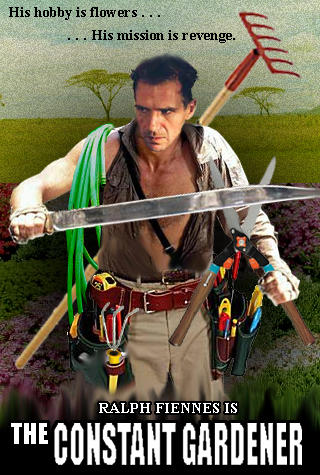
The film really hits it’s stride when Yuri strikes up business with African dictator Andre Baptiste (Eamonn Walker) and his gold-plated AK-47 carrying psycho/cannibal son. The film’s welcome cynicism about it’s primary subject extends (perhaps even increases) to his African clientel, and the films renderings of despotic, tribalistic war zones bludgeon the glossy fable of “The Constant Gardener” with it’s saintly third world victims and guilt-ridden, martyred Westerners. Yuri’s quick-fix solution, at one point, to the imminent capture of his planeload of contraband is so strikingly un-PC I nearly clapped for joy. So many films treat the chaos in Africa (Western-made, self-made or otherwise) with such delicate gloves, terrified to render native African characters as anything but one-dimensionally noble, that it’s a real joy to see one where these characters are afforded the same dimension and moral complications as the leading-man American…

…who is, of course, an almost-completely ammoral but imminently-likable guy. As played by Cage, Orlov is the sort of character who starts out complicated and only gets moreso, but eventually can be defined by a simple trait: He does what he does because he likes being good at something. It’s villiany as a matter of pride, and like any rise-and-fall antihero worth his salt it’s both his strength and fatal flaw. You may or may not wind up rooting for him to get away with what he does, but chances are you’ll be entertained watching him try.

Time will decide if “Lord of War” gets to be as enduring as “Goodfellas” or it’s other kin. But for now, it’s an extremely good, entertaining movie very likely playing near you, and you should definately make a point to see it. Reccomended.

FINAL RATING: 9/10

REVIEW: Venom

“Venom” isn’t a good film by any means, which is the BIG reason why you haven’t seen it advertised or promoted hardly at all. The other reasons are more due to bad luck than bad filmmaking: It has the misfortune of being an R-rated slasher opening against the PG-13 rated “Cry_Wolf,” of being distributed by the soon-to-be-no-more Dimension Films and of being set in the swamps of Louisiana which, you may have heard, are “sensitive material” right now. A run of lousy luck like that would be a lot for a good movie to overcome, and it’s certainly too much for “Venom.”

And yet, bad luck and all, I’m surprised to find I can’t really give this a wholly bad review. Taken entirely on it’s own merits, which is to say as a B-grade slasher with a voodoo/zombie tweaking, it’s largely functional. It’s principal cast is inoffensive and earnest, it’s “monster” is amusing, it’s gore is well used and it puts just enough novel spin on the undead-stalker-of-rural-teens formula to qualify as a genre-entry of note in it’s own right.

The victims-in-waiting here are a gaggle of Louisiana teenagers (played, in a pleasant surprise, by actors who actually look like teenagers.) The “main heroes” are a nice guy who’s content to live out his small town life and his girlfriend who pines for the big city. The evil MacGuffin is a suitcase housing a pair of magical snakes that had been used to suck out and contain the evil energy of countless murderers, criminals and sadists in voodoo last-rites ceremonies. Through various complications, the local Redneck Meanie (a garage mechanic) drowns in the swamp, gets nibbled by said snakes and transformed into a super-powered killer zombie who takes off on a killing spree, using tow-truck chains and his trusty crowbar as weapons of choice.

As setups for “Friday the 13th” lifts go, thats not bad. The only “duty” left to the film after that is to provide good death scenes (it’s largely successful) for engaging characters (it’s less successful.) The Bayou provides a nice change of scenery from the usual suburban schools and campgrounds in these movies, and as an honest-to-god slasher film it’s much better than the bloodless (in every sense) “Cry_Wolf,” while as a voodoo-tinged shocker it’s got more real suspense than the classy but never-ever-scary “Skeleton Key.”

It’s the little things that make the difference in these movies: I like the use of a crowbar in place of the usual machete or hunting knife. I like that the characters (for the most part) don’t meet their ends in the order I was expecting. A pair of kills involving a forked-road and a sandblasting machine are inventive. The baddie (named Ray) is clever and more resourceful than usual. A section in the middle, involving a makeshift voodoo ritual, is about the most creative “stop the monster” weapon since the paper-folding in “Tales From The Hood.”

It ain’t “good,” but if you need to see a new slasher movie this is the one to see.

FINAL RATING: 6/10

REVIEW: Just Like Heaven

I know some of you are seeing the trailers for this and thinking, “wait.. didn’t this already suck once as ‘Ghost?'” I know this because I was thinking the same thing, and I’m rarely quick enough to have told a joke first.

Either way, we were both wrong. Totally wrong. Here, instantly, is one of the best romantic comedies of the year. And I say this as someone who typically loathes romantic comedies. Each day comes with it’s surprises.

This much you know from the trailer: Reese Witherspoon is Elizabeth, a workaholic do-gooding doctor who’s skooshed in a car crash in the opening moments of the film. Mark Ruffalo is David, a depressed but good natured guy who rents a furnished San Fransisco apartment only to discover it’s haunted… by Elizabeth’s ghost. After some slapsticky playacting in “Beetlejuice” territory as to her innability to admit her own death and the first of three surprise plot twists, the real story is up and running: Solving the mystery of why Elizabeth hasn’t crossed over and why David is apparently the only one who can see her now. Oh, and falling in love with one-another, of course.

Help on all these tracks comes in the form of an occult bookstore owner (Jon Heder, late of “Napolean Dynamite”) who drops by to explain the film’s hook: Elizabeth is way too alive to be dead, and for a live person David is way too dead inside. Get it? Also on hand is Donal Logue as David’s psychiatrist buddy, who helps out in the third act when some lightly-illegal slaptick rescuing is required.

Yes, it’s all just too cute for words. But it works, because the leads are good at this, because the supporting cast is efficiently used and the script is a great deal smarter than it needed to be. The supernaturality of the plot is actuality it’s main non-romance focus, as opposed to a contrivance. The result is that, while it certainly works as romantic comedy, this is actually one of the more accutely spiritual movies to rear it’s head in awhile.

About the actual plot not much more can be said. The film turns on a series of surprise revelations about the circumstances of it’s protagonists, the “big” one of which I personally found a little easy to guess but the second of which really caught me off gaurd and changed the nature of the film for the better. (A third, concerning the possible extra identity of a supporting player, is saved for the coda.)

There’s really not much more to say other than… what a nice surprise. I really enjoyed this one, highly reccomended for the date crowd or otherwise.

FINAL RATING: 8/10

REVIEW: Cry_Wolf

“You’re not as smart as you think you are,” the unnervingly Val Kilmer-esque Westlake Prep journalism professor played by Jon Bon Jovi cautions Owen, the nominal hero of “Cry_Wolf.” He could just as easily have been describing the film itself, yet another too-clever-by-half teen slasher entry with pretentions of parlaying self-awareness of it’s own genericism (genericity?) within the genre into a kind of postmodern hipness. File it under “Scream,” with an asterixed notation that at least “Scream” took almost half a decade to get tired and dated, while “Cry_Wolf” accomplishes the same before it’s even finished it’s running time.

Owen (Julian Morris) is the new kid (from Britain, even) at Westlake, a postcard-perfect prep school somewhere in the Northeast. It’s big, it’s old-looking, and it’s stuck in the middle of a deep dark woods. Chasing the affections of resident hottie ice-queen Dodger (Lindy Booth,) Owen gets mixed up with a Scooby Gang of friends who pass the time playing mind games. When Owen’s Sherlockian observational skills render their original games overly simple, they begin a new one: Using the recent murder of a townie girl as a basis, they start a rumor via an Email chain letter that a not-Jason-Vorhees serial slayer called “The Wolf” is stalking the students. Almost immediately, threatening AIM messages are getting sent, wierd doin’s are transpirin’, and someone dressed up like The Wolf (neon ski-mask and cammo jacket, *yawn*) is following the main cast around in the dark.

Extrapolate from there on out, and you’ll probably imagine a movie at least slightly better than what’s actually offered. We’ve been through this too many times: Everyone thinks everyone else is behind it all, friendships are tested, allegiances are formed and reformed. Yes, red herrings are swimming all over the margins of the frame at all times. Yes, various characters are only able to absolve themselves of suspicion by revealing deep, dark secrets about themselves. Yes, there are montages in which various scenes we’ve already witnessed are replayed with “but then THIS HAPPENED!!!!” extra endings. By the end, the only fun to be had is guessing which cliche of both the prep-school-drama and teen-horror genres will make it’s appearance next. Cladenstine teacher/student copulation? Check. A costume party making difficult the pursuit of a costume killer? Check. Fogged-up mirrors? Don’t even have to ask. This is tedious, plain and simple.

It didn’t have to be. The slasher film has endured precisely because it’s formula is basic enough to be tweaked interestingly by seemingly minor variations. Merely coming up with new and creative murder-weapons has kept “Friday The 13th” undead and kicking for eleven movies and counting. Absent that option (and blessed with the sacred PG13 rating for the trouble) there’s still room to grow by stocking the film with intriguing or unexpected characters. Instead “Cry_Wolf” has only the usual mandatory grab-bag. Roll call: Good Guy, Redneck, Fat Guy, Freaky Guy, Black Guy, Slut, Geeky Chick and Hot Bitch. Everyone’s present and accounted for.

The film even lacks in the realm of theme and narrative design. In spite of all the PDAs, cell phones and AIM connections that figure so prominently, no attempt is made to spin this out into some kind of commentary on techno-age detachment. The closest we get is the use of AOL Instant Messengers signature (and obnoxious) “bee-doomp!” alert bell as a kind of product-placement substitute for “one, two, Freddy’s comin’ for you.” This is either the most bloodless slasher film ever, or the most violent infomercial ever.

Skip it.

FINAL RATING: 3/10

REVIEW: The Exorcism of Emily Rose

WARNING: The new film “The Exorcism of Emily Rose” nominally presents itself as a mystery, and thus any serious discussion of the film and it’s merits (or lack thereof) will contain SPOILERS. You have been warned.

Here is one of the great consistent ironies of the modern cinema: The horror genre, subsisting as it does largely on violence, sex and demonic imagery, is generally tops amongthe genres hated and cited as cause for censorship by religious organizations. However, the horror genre also subsisting as it does largely on the “reality” of demonic forces, good-versus-evil and the power of religious symbology, is the most consistently devout of modern film genres. To date, “The Exorcist” remains the most bluntly pro-religion film made by any major studio in the modern era, crucifix-masturbation and all.

So it’s not really a surprise that “The Exorcism of Emily Rose,” though it’s being marketed as a straight horror film and maintains self-illusions of a courtroom drama playing out the grand questions of secularism versus faith, can only retain it’s pretense of open-mindedness for so long before it collapses into both the traditional hokum of genre cliche’s and, perhaps also, a work of only semi-intentional propaganda on behalf of doctrinaire fundamentalism. It’s a film that seems to struggle, ultimately in vain, to remain a serious exploration of both sides… but is ultimately defeated both by a desire to be an effective scary movie and deliver a religious message, BOTH of which demand a single-mindedness that makes serious exploration impossible.

But first to the movie itself…

Let’s get one thing out of the way right now: despite what the film’s promotions, trailers and even it’s final codas tell you, this is NOT A TRUE STORY. There is no Emily Rose, there never was, and that’s that. The “based on” in “based on a true story” here refers to the 1976 case of German teenager Anneliese Michel, who believed herself posessed numerous demons (Hitler and Nero among them) and who was “exorcised” often multiple times in a day by a succession of multiple priests. When this experience eventually killed her, the priests and her parents were charged with negligent manslaughter and subsequently found guilty.

Aside from reimagining Michel as Emily Rose, the film also relocates the story to present-day rural America, reduces the number of priests and exorcisms to just one and leaves the rest of the Rose family out of the charges. Thus, the courtroom drama which frames the film is able to serve double-duty, “Inherit The Wind”-style, as an open forum to argue out the broadest possible competing points of religiousity and secularism: Accused of negligent homicide in the death of Emily Rose, (Jennifer Carpenter,) Father Richard Moore (Tom Wilkinson) is sent to trial. Campbell Scott is the devoutly-Christian prosecutor Ethan Thomas (as in “Doubting Thomas?”) and Laura Linney is agnostic rising-star defense attorney Erin Bruner who takes the case for the career boost.

So, yes, the non-believer is representing the priest who’s guilt or innocence largely depends on one’s commitment to the spiritual, while rationality and the law of the strictly-physical is represented by a churchgoing Christian. Such irony! Can’t you just see the screenwriter grabbing a celebratory second muffin to congratulate himself for such cleverness? In any case, here’s the meat of our conflict: Father Moore is unafraid of verdicts or jail-time, he desires only his attorney’s promise that he be allowed to use his testimony to tell the world “the truth about Emily.” However, the Catholic Archdiocese paying for his defense would prefer he not say anything and just let the matter pass with minimal publicity.

Which track will Erin take? Will her lack-of-faith be tested by possibly-demonic encounters of her own? Will the innevitable resolution of this conflict cause an otherwise intriugingly ambiguous mystery story to go off the rails into 3rd-act speechifying? Are the courtroom scenes increasingly stacked in favor of one side? Do you really need to ask? (What I really need to ask is who told Campbell Scott it would be a good idea to play his role by doing an impression of Tom Skerritt.)

Despite a clunky opening, (Linney gets one of the most laughably exposition-dense character introduction scenes I’ve ever seen,) for the most part the film settles into a well-executed, comfortable pace for the most part: The courtroom scenes are well acted and efficient, even if it does all play out like “Law & Order: Satanic Victims Unit.” We see the events leading up to Emily’s death in flashbacks, often from both “believer” and “skeptic” viewpoints, and relative newcomer Carpenter throws herself into the Linda Blair role with gusto: Her Emily Rose; wild-eyed, clad often in a sopping-wet rustic nightgown, gifted with remarkable contortionist skills, shrieking in Aramaic and eventually Stigmatic, recalls both the beasties of “Evil Dead” or (to me, anyway) a pinup fantasy for Mel Gibson.

All of this stuff works really well, helped greatly by a talented cast of (mostly Canadian) top-tier acting talent. But they can only do so much, and soon enough the problems start to pile up. That the courtroom drama stacks the deck in favor of the defense is kind of innevitable, but it gets too far out of hand too soon: A witness giving the “skeptical scientist” side for the prosecution is, of course, an oily creep with subtly-gray fleshtones and a cold stare, while the defense counters with a spiritualy-inclined scientist played by Shoreh Agdashloo (“House of Sand & Fog” and “24”) as an ethereal multi-culti Earth Mother archetype (this actress deserves better, she’s mostly here to name-drop Carlos Castaneda for all you smarty-pantses in the audience.)

But the film doesn’t really slip up until it’s final act, the discussion of which warrants yet another MAJOR SPOILER WARNING…

…Come the last act, “the truth” comes into play and the film basically drops all pretense of being an objective observation of a debate-as-story. It’s eventually not enough for the film to argue that Father Moore might not be crazy in his beliefs, it has to turn the whole case (and the movie) into a referendum on the need for spirituality in the modern world; “will Father Moore be found innocent?” morphs inexorably into “will the jury realize the need to let Father Moore go in order to strike a blow for faith against the tyranny of the scientific age?” without a second thought.

A final twist, involving a piece of evidence clumsily hidden from the audience until the last possible moment, gives the film a coda that would be shaky in a Bobsey Twins opus: That Emily’s posession, her death and the resulting trial have actually been a grand piece of human theater staged by God as a way to remind people that Demons and, thus, their Angel enemies are still very much real. Seriously, that’s what happens: God “dunnit,” multiple deaths and all, in a bid for our attention. Evidently, appearing in misshapen pastry and on the back of Mexian highway signs just isn’t cuttin’ it anymore.

I’m actually wondering if the filmmakers realize what is being suggested by going this route. Do they even realize that they’ve essentially made a film who’s message is: “The Lord works in mysterious ways, so don’t question the actions of priests or anyone else carrying out his orders no matter how wrong they look to us mere mortals.”?

This isn’t to say that, if indeed the film is taking the form of an argument in favor of hardline religious fundamentalism that it’s automatically “bad.” In fact, it’s overall a solid bit of work and, after all, “Birth of A Nation” and “Triumph of The Will” are still both important works of cinema despite championing the Klu Klux Klan and Nazism, respectively. The problem, rather, is that you need to be a filmmaker of incredible skill to make a climax this out-of-left-field work, and that’s just not the case here. Every argument, no matter how ridiculous, can be made… just not by everyone.

Much like the similarly-afflicted “Frailty” of a few years back, “The Exorcism of Emily Rose” is an extremely interested, well-made and well-acted film that just isn’t good enough to justify the extraordinary reach it asks a thinking audience to make. What begins as a clever fusion of courtroom drama and horror show ends up looking like a “Perry Mason” fanfic scripted by Pat Robertson, and the quality nosedives into strictly-average territory. But while the good parts last, they’re good enough to justify a look.

FINAL RATING: 5/10