REVIEW: Apocalypto

WARNING: Since the film’s trailers have been telling you almost nothing about the movie, for a change, this review can be considered positively loaded with SPOILERS. You have been warned.

When you get right down to it, Mel Gibson’s “Apocalypto” is really just one more action/chase movie in which a single man makes mincemeat of an army of foes in order to (alternately) rescue and avenge the deaths of his friends and family, dressed up with subtitles and symbolism so that it may (partially) cross-dress as an experimental arthouse exercise. Imagine that Michael Bay has killed Werner Herzog, fashioned his skin into a suit and charged, shreiking, off into the wilderness and you’ll have a pretty good idea what the result feels like: A schizophrenic hobgoblin of a movie that appears to have bound forth fully-formed from the diseased recesses of a dark and troubled mind, careening back and forth between the dreamlike state of a nightmare and the more familiar realm of rigid, lockstep genre formula as Gibson further refines the “Boy Versus The World” mythology he’s been mining as an actor and director since we first met him as Mad Max all those years ago.

It’s been said for quite some time that most, if not all, testosterone wish-fulfillment actioners function as love-letters to primitivism; their heroes so often successful only after embracing their inner cro-magnon. Recall “Die Hard’s” John McClaine, streaked in blood and stripped of his shoes before he can confront the suit-clad Euro-foes. Recall John Rambo’s retreat to the Forest Primeval to gain the edge of his better-armed pursuers in “First Blood.” Recall that same John Rambo again in the sequel, rising camoflauged from the mud, shorn of clothing down to rags and a bare chest, taking down his enemies with weaponry which represents an entire epoch of pre-industrial human civilization… a bow and arrow.

“Apocalypto,” in a way, represents an absolute boiling-down of this particular aspect of the genre’s subtext; it’s hero need not return to The Forest to recharge his heroic instincts, he’s already there: Jaguar Paw (newcomer Rudy Youngblood) is a young husband and father in an unnamed hunter/gatherer tribe still living a peaceful Stone Age day-to-day existence despite their living (unknown to them) just on the outskirts of the advanced Mayan civilization during what is presumably sometime between the late 16th to 17th Century.

It’s through this fascinating choice of setting that the story is able to continue it’s overall merging of outward-otherworldliness with structural-formality: Amusingly, despite the filmmakers’ gutsy achievement in crafting the first major motion picture set entirely among pre-Columbian Native American peoples in a Native American language, the film still manages to place it’s characters in the same basic formula that Native American stories have been limited to for the last few decades: The clash of a good, Earth-centered, nature-connected tribal group (Jaguar Paw’s people) and the evils of a corrupt, ecology-despoiling “advanced” civilization… the sole (but key) difference this time being that the Big Bad City-Dwellers are the also-native Mayans instead of the usual Europeans.

The Mayans sack the Peaceful Village of the good guys, snatch up Jaguar Paw and anyone left standing (JP has managed to hide his son and very pregnant wife in a rocky crevase, promising to retrieve them) and march them off to the Capitol City as sacrifices. They are, we learn, themselves ravaged by plauge and famine which, the film argues, are larger symptoms of a civilization rotting from within. Gibson dwells on the gory pagentry of the Mayans in a showpeice central scene of heart-ripping, head-hacking temple sacrifice. He lingers on the details of a field of corpses or the gatuitous (but undeniably awesome from a veteran-gorehound stanpoint) effects of stone-age axes, spears and arrows on the human skull with an eye that resembles no other filmmaker so much as Ruggero Deodato, the infamous Italian exploitationeer who’s “Cannibal Holocaust”-era lost-in-the-jungle madness Gibson appears to have absorbed wholesale into his growing repetoire of personal psychosis. (And for those who thought that there was no possibility that even the maker of “The Passion of The Christ” could find a way slip a crucifix into a movie about the ancient Mayans, well… you’ll just have to see.)

By astonishing coincidence (a phrase that can describe more than half of the big scenes in the film, just for the record) JP escapes this fate and beats feet back to the wife and kids with a platoon of Mayan Soldiers on his heels. the film holds so rigidly to formula and often outright-cliche that, were it to crop up to this degree in almost any other context it would be nearly unforgivable: Jaguar Paw’s people are set-upon and ravaged by the Mayans in a scene that mimics almost beat-for-beat it’s analouges in “Conan the Barbarian,” Gibson’s own turn in “The Patriot,” and pretty much every other movie that has used this same opening to this same story before. There’s the Pre-Setup Benign Tool That Later Becomes A Crucial Weapon from “Straw Dogs,” the Hero Clasps Trinket Of Dead Or Endangered Loved One For Strength from “Rambo,” the One Vine Above The Quicksand from, well, from every jungle movie ever made, there’s the Leap Of Fate From The Waterfall from… take your pick, really. But here, perhaps, such adherence to the familiar is important: In a film with no recognizable stars, language or even terrain for the majority of it’s prospective audience, the formula serves as both an anchor and a portal through which said audience can enter and find footing.

Less easy to forgive is the fact that it’s 2nd act is, literally, a ludicrous succession of Deus Ex Machina escapes for Jaguar Paw, as he’s aided in his flight from the Mayans by everything from a solar eclipse to a handily-placed viper to an actual Jaguar… all of these mounting coincidences “excused” earlier by… no, I’m not making this up… a plauge-ridden little girl who appears to the Mayans hissing a symbolist prophecy of impending doom. No, really, that’s actually what happens.

Let it not be said that Gibson doesn’t have an eye for detail: I’m no historian, but the costuming and occutraments of the Mayan bad guys look authentic as hell to me, as does the functionality of their lethally-ingenious weaponry. And the film has great fun (and invites us to join in) showing off the way Jaguar Paw turns his forest surroundings into one big arms cache; lobbing beehive “grenades” at his foes and snatching up a brightly-colored frog to assist him in quickly preparing some poison darts. My personal favorite: A brilliant application of ants in the suturing of a wound. By now, in addition, he’s a well-learned stager of action scenes, giving what is essentially a prolonged foot-chase the kinetic thrills of a high-speed pursuit, and he knows how to turn a rain storm into a mini-armageddon in it’s own right. And while I’ve seen more than enough movie moments where childbirth complicates an already-raging action scene, I doubt I’ve ever seen it quite like this.

Putting aside, as best one is able, all the hangups and obsessions of it’s maker (be they the ones screamed at police officers or the ones evident in the filmmaking) “Apocalypto” is a one-of-a-kind animal, and that in and of itself qualifies it as something you should seek out. It’s as brilliantly-realized a work of mad, hell-bent genius as you’re likely to see this year; an action movie with the energy of a madman… crafted by a onetime action movie-star who just might be one himself. Whether or not continued exposure to the deeper and darker corners of the Mind of Mel will be, in the long term, a learning experience or an ordeal for The Cinema as a whole remains to be seen, but this time… THIS time… it’s yeilded something genuinely worthy of study.

FINAL RATING: 8/10

The BEST poster tagline of next year!

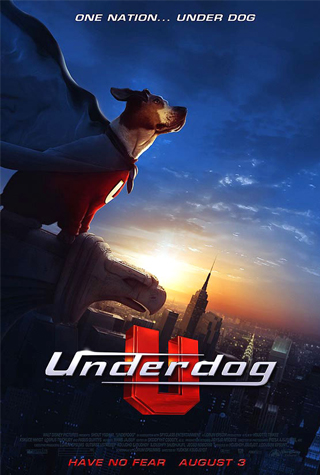
If there WAS a competition for such a title, it would already be over. With a hat-tip to AICN ( http://www.aintitcool.com/node/30961 ) here is the first teaser poster for Disney’s August 07 slated live-action reworking of “Underdog”:

“One Nation… Under Dog.” YES! Perfect, perfect, perfect. Everything you want in a tagline: It’s cute, it’s clever, it’s just dopey and eyeroll-inducing enough to permanently brand it into the brain of anyone who reads it. I’m literally smiling or outright laughing every damn time I read it. And it’s the perfect compliment to the poster itself, both of them deftly capturing the promise of canine-themed ribbing of Superhero Movie bombast. As poster art goes, this thing is gorgeous, so perfectly evocative of the “Spider-Man”/“Superman Returns” key art design schematics that it actually takes the eye a crucial extra moment to realize that it’s an adorable puppy-dog in a cape perched on that familiar-looking gargoyle instead of an angst-ridden costumed-vigilante.

I’ll confess to having been extremely fond of re-runs of the cartoon, one of those gloriously bizzare dialogue-heavy mid-1960s network cartoon quickies, as a young’in, so it’s a little “odd” at first that they’re going the route of a “real” dog turned “super,” though it does seem the only way to capture in live-action the odd concept of the show where Underdog is an anthropomorphic dog in a world of “normal” humans. And it’s undeniable that the little fella IS too cute for words, overall a fitting remedy for the fact that Superman’s dog Krypto will likely never see screentime in a live-action feature. I know it’s unwise to trust that Disney will make something good out of this, but they did just produce one of the best superhero spoofs EVER in “Sky High,” so you never know. Bottom line: A movie that actually delivered on what this poster promises would be friggin’ awesome.

BTW, I agree with AICN’s Merrick: Almost as awesome as that tagline is the prospect that, if this really is the final “hook” line for the movie, the “religious right” will pitch a fit over “mocking a reference to the Almighty.” That’s my kinda icing.

REVIEW: Blood Diamond

Let us now consider the Paradox of Edward Zwick. Zwick is a moderately-prolific filmmaker of great talent, who specializes in grandly-mounted sagas which also function as “issue” films. He is, demonstrably, so determined that the audience recieve the messages he aims to impart that he is willing to build expensive mass-appeal action/dramas around them. The paradox is as follows: Zwick’s films are too often concerned TOO much with making the message as accesible to his primarily Western/European audience; to the extent that despite often being based in fascinating stories of African-American (“Glory,”) Japanese (“The Last Samurai,”) or African (“Blood Diamond”) history, they twist and contort themselves into a gangly mess in order to spotlight a white/western hero.

“Blood Diamond,” ostensibly an action thriller set amid the world of Seirra Leone “conflict diamond” (diamonds mined and sold to the West in order to finance guerrilla terrorist groups) smuggling in the 1990s, thusly becomes Zwick’s latest well-intentioned exploration of a theme which can easily be summarized by paraphrasing Homer Simpson’s thoughts on alcohol: “White people: The cause of AND solution to all of life’s problems.”

The ever-commanding Djimon Honsou technically drives the plot as a poor African fisherman shanghaied into mining the titular diamonds by a savage gang of terrorists. When he finds stone of incredible size and worth, he hides it and runs away, aiming to use his find as leverage to reunite his war-displaced family (including a son who has been brainwashed into the guerrilla’s squad of “child soldiers.”) But the film focuses it’s “hero arc” and lead story on Leonardo DiCaprio as a South African mercenary turned diamond smuggler who offers to “help” Honsou, seeing a 50/50 split of the diamond as his ticket out of war-torn Africa. So determined is the film that DiCaprio remain at it’s narrative focus that it provides him a love interest: Jennifer Connelly as, yes, a Crusading Journalist who (say it with me now) Is Looking For THE STORY To Make America Care.

So, yes, once again we have the troublesome case of a film which is technically superb and even rousing as an above-average action peice; but is so determined to Make. People. CARE. that it undermines it’s own overall effect by embracing unnecessary familiarity and rigidly formulaic story beats. So, yes, just looking at what the film wants you to feel and the lineup of characters delivers an instant roadmap of every single thing that will happen. You know who will live, who will die, and what will transpire along the way. You’ll know the precise plans and fates of our two villians, (one white, one black) and everything else that will occur over the course of the feature.

None of that, of course, is meant to suggest that “Blood Diamond” isn’t a good film, it is. It’s just not the GREAT one it could have been if it had put the focus where it belongs (on Honsou’s character) and not been so committed to such a tired Issue Movie formula. There’s great stuff in there, the highlights being the chilling scenes of the terrorist indoctrination used to create the Child Soldiers and Honsou’s overdo chance at getting to do something at the arrival of the third act. The pace is tight, considering it’s a fairly lengthy story, and Zwick remains a criminally underrated director of action.

One of these days, Zwick WILL top “Glory” and make the Movie of His Career, and it’ll be the day he redisovers the desire to make the audience care as much about the MOVIE in equal proportion to the desire to make them care about the issue.

FINAL RATING: 7/10

PS3 Commercials…

My, by I’m sick of Sony’s weirdo “Look! We watched a Naya Deren movie once!” PS3 commercials, and not just because they remind me of the similarly head-scratching 3DO ads from way back.

So I did something about it. Enjoy!

REVIEW: The Nativity Story

NOTE: Look, we all know it’s not possible, fair or honest to talk about this movie without at least a mention of “The Passion,” so I’ll get that detail out of the way first.

When “The Passion of The Christ” was breaking boxoffice records, there emerged two competing “explanations” for why a pornographically-violent Aramaic-language film was earning so much money. The first theory, trumpted by the film’s fans and supporters, was that the massive B.O. take was evidence of a long-unslaked thirst for Christian entertainment from the American moviegoing public. The alternate theory, concluded by the film’s detractors (myself included) was that the film was making most of it’s money not based on it’s actual “value” as a film but because of the “movement” behind it: That it’s “fans” were buying tickets and talking it up not because of the film itself but because “supporting” it was touted in certain powerful circles as a method of “striking back” against, well… Democrats, “Liberals,” Jews, Homosexuals and everyone else the power-brokers of the Fundies are convinced “run” the entertainment industry. (It will come as no surprise that “maybe it’s a little of BOTH” was not generally considered a viable compromise by either side.)

Implicit in either theory is that the “proving” would have to wait until the NEXT wide-release Hollywood film with a devoutly Christian religious theme: If said film is a similar juggernaut, then there just might be something to the notion of “middle America” crying out for big-budget Bible movies; if it’s not, well… then the theory that “Passion” was a phenomenon of marketing and politics, not filmmaking and spirituality, gains significantly more credence.

Fair or not, the first major Hollywood “Christian Film” post-“Passion” is Catherine Hardwicke’s “The Nativity Story,” and it has now opened in wide-release in the middle of the Christmas season… at 4th place. So, yeah… even taking into consideration a probable uptick in sales as the holiday approaches… it looks like “Passion’ was a manufactured, politically-motivated exception” has the edge among the theories. Sigh. I hate being right sometimes, and this would be one of those times. Because “The Nativity Story” is a genuinely good, worthy film, and while it’s all well and good to have this “see? The emperor is NAKED!” moment over “Triumph of The Mel,” it’s kind of sad that this film has to take the “hit” to bring it about.

“Nativity” concerns itself will the conception and birth of Christ, with the main arc of the story focused on Mary (“Whale Rider’s” Keisha Castle Hughes,) here pictured in terms of (likely) historical accuracy as a teenaged girl coming of age in Nazareth; an impoverished rural community straining under the harsh rule of both Ceasar Augustus and Herod, the cunning but paranoid King of Jerusalem. Herod is deeply protective of his lavish lifestyle, the upkeep of which requires that he keep order on behalf of his Roman colonial superiors. The greatest threat to that order, in his eyes, is the mounting belief that the ancient Hebrew prophecy of the birth of a Messianic “New King” is soon at hand.

Soon after finding herself betrothed to the older (but good-hearted) Joseph, Mary gets a head’s-up from the Angel Gabriel that she is to give Virgin Birth to said Messiah. This turns her into something of a local pariah among her devout village, but faith (and loyal support from her new Husband) helps them endure… until they recieve a greater test of being forced on a long journey to Bethlehem to register for census; a ploy of Herod’s which coincides with the journey of three Magi (“Wise Men”) who are following an astrological sign which they believe will lead them to the Messiah.

The film succeeds mightily both in being a solid, focused character drama while at the same managing a visual and structural synthesis of the general understandings and conceptions about the story. In plainer terms, the film perfectly captures the essential events, compositions and beats from the “everybody knows” version of the story while affording the characters room to become deeper than the porceline figures on Grandma’s shelf this time of year.

Specifically, it gives greater nuance to Joseph, rendering him as a man compelled to do the right thing even when unsure or not able to understand what he’s found himself involved in: In one terrific touch, the event of Gabriel reassuring Joseph of Mary’s fidelity in a dream is presented as the angel interupting a nightmare in which Joseph imagines himself as part of a mob gathered to stone Mary for adultery; while a clever earlier scene affords the ubiquitous donkey an origin of it’s own.

Also getting more dramatic attention than usual are Mary’s elder cousin Elisabeth (Shoreh Agdashloo, late of “24” and “House of Sand and Fog,”) and her husband Zachariah, portrayed as an older couple from whom Mary recieves basic lessons in the ways of parenthood. The oft-omitted subplot of Zachariah’s temporary muting even makes an appearance, as no servicable Bible retelling can exist without at least one sequence of The Almighty being inexplicably “jerky.”

The film finds a working visual balance between the traditional “nativity scene” renderings and the now-current go-to look of big-budget “ancient” and/or mystical films (it’s best to just accept that “Lord of The Rings” is now the Rosetta Stone of such films for the forseeable future.) Special mention needs to be made of the score, which sublty blends the classical music and hymns generally associated with the story; listen close, you’ll find the strains of “Emmanuel” and “O Holy Night” drifting in right where they ought to.

This is a terrific little movie, a well-made mini-epic superior in every way to “Passion” or most other recent religious films, period. It’s bound to have more ressonance, of course, to Christians or others more immediately invested in the material, but for what it’s worth it’s a fine film and towards the end stirred some of my long-dormant memories of seeing/hearing this stuff told back when I was much younger and it all seemed much more involving; which I assure you is no small feat.

FINAL RATING: 8/10

REVIEW: The Fountain

WARNING: Review will contain minor plot spoilers, and is preceded by lengthy Harry Knowles-ish tangential digression. But you’ll also get a funny clip from YouTube.

Has this ever happened to you?

You see this girl (YES, I call women my own age girls, and I’m sticking with it.) She’s gorgeous. Fascinating. Different. Breath-of-fresh-air. You can tell. Oh, she’s pretty, sure… but thats not the important part. That’s not what made you look twice. No. It’s the “different” part. The “weird” part. Oh, not bad weird. Not “Kathy Bates in ‘Misery’ weird. No… she’s good weird. “Kate Winslet in ‘Eternal Sunshine of the Spotless Mind’ weird. Helena Bonham Carter in “Fight Club” weird. Off-puttingly-adorable-goth-chick-who-works-at-the-music-store weird. We’re all on the same page now, right? HOT weird.

And not just weird… INTERESTING! Maybe you heard her say something super-clever about some obscure topic you swore only you would say something like that about. Maybe it’s the tattoo of unidentifiable origin. Maybe it’s just the six different dye colors in the hair, whatever it is, you’re mind starts going “she’s gotta be fascinating. Deep. Talk to her for hours. New surprise every day.”

So you’re hooked. But you don’t just go ask her out. No, of course not. That’s what rational, proactive people do. That’s what people with guts do. No, your smitten ass has to go “find out” about her. You’ve gotta ask mutual aquaintances about her. “So-and-so? Eh, don’t know her too well outside whatever… but she seems like a TRIP, right?” What’s that, you say? She has a LiveJournal!? Well, let me read THAT whole damn thing… WOW! It’s so weird, so interesting, you were totally right!

So you ask her out. Finally. And she says yes. You pick yourself up off the floor, and you’re PSYCHED. This is it. Good times are coming. She’s gonna expand your mind. Thrill your senses. Maybe you’ll wake up someplace cool, like a belltower; or in some story-worthy condition, like with fang-marks in you’re neck. Or.. y’know, maybe you’ll have great connection over dinner, hit it off and begin a meaningful, fulfilling relationship. Either one is good.

And then you actually go on the date and… Meh. Oh, it’s not a disaster. She’s… nice. Friendly. Pleasant company. Good new aquaintance. But at some point, earlier than you’d have thought, you arrive at a slightly dissapointing feeling: “Hm. She’s not quite as ‘interesting’ as I’d thought she was” (For me, this feeling usually pops up right after “Omigod.. don’tcha just love Meg Ryan?”)

Now, to be fair, most of this is your fault. You’re a male, so you have largely unrealistic expectations of women, and you’re a geek, so the unreality of those expectations is fantastical to the point of absurdity – you’re model of the feminine ideal falls somewhere at an intersection between Chun-Li and Lady Ewoyn.

And then, you get another feeling. Probably right around the time she starts in about something “important.” Oh, don’t misunderstand, she’s still cool. Fun. Good new lady-friend. But you’ve hit a realization that’s a definate buzzkill in terms of attraction: “Uh-oh. She’s not as interesting as SHE thinks she is.”

Eh… y’know what? This “Family Guy” clip says it better than I can:
http://www.youtube.com/watch?v=dyuPip3i3Vc


ACTUAL REVIEW (with minor spoilage) BEGINS HERE

So… finally getting to see “The Fountain” is kind of like that. For me, anyway.

For how long have we been hearing about this movie? This next-step masterpiece from Darren Aronofsky, seemingly doomed but rescued and given a second chance AND a big holiday release? This visual “trip” who’s promotions promised a dizzying time-and-mind-bending rush? The trailer’s, featuring science labs, Spanish conquistadors, magic trees, flaming swords and bubble-based space flight?? There’s that feeling again: It looks different. INTERESTING. HOT weird.

And then you go, you buy the ticket, you’re ready to have you’re mind blown. Here it comes and… Hm. Oh, it’s GOOD. Let’s be clear here. This is a solid, well-made, well-acted peice of moviemaking, certainly more original overall than most other things you could be watching right now. And yet… nope. My mind falls kinda short of “blown.” My senses decidedly not-shredded. I didn’t wake up in the belltower. “It’s not as interesting as I thought it’d be,” yup. And, sadly, “it’s not as deep OR interesting as IT thinks it is,” either. In terms of overall effect, it calls to mind no film more than “What Dreams May Come,” and somehow I don’t think many of us are heading into a promised Darren Aronofsky mind-screw to get the same feeling one gets from a flawed but visually-sumptuous Robin Williams vehicle.

What we have hear are three “parallel” stories which are not exactly parallel but have something or possibly everything to do with one another. In the first, Hugh Jackman is a Conquistador charging into battle against a Mayan shaman to retrieve the sap of the Biblical “Tree of Life” (the “Fountain” of the title is meant as-in “Of Youth,” for the record) for his immortality-seeking Queen (Rachel Weisz) who’s quest for the Fountain has made her the target of an evil Priest who has deemed her quest blasphemous and is using the power of The Inquisition to impede her.

That story occurs in the pages of a book being written by a cancer-ridden woman (Rachel Weisz again) in the modern-set main story. She’s married to a brilliant scientist (Jackman again) who is obsessively trying to save her by researching a miracle cure (get it?) derrived from “a mysterious tree in South America.” What he gets could indeed be called a Fountain of Youth… but it doesn’t cure cancer. In the “final” story, set in either the real or imagined future, Jackman’s scientist is now a bald holy man, practicing Buddhist-style meditations as he hurls through outer space in a magic bubble, the Tree of Life (and his memories) his only companions.

The three stories bend and twist around eachother, eventually wrapping the story up into an intricate narrative not that promises to conceal something deep, profound and fascinating once unfurled. Sadly, that promise isn’t quite delivered on, and all the bombast and weirdness eventually appears designed to conceal how simplistic and (sorry, but it’s true) predictable and mundane it’s themes and messages are.

Tell me, had you heard before that “the quest for Eternal Youth is self-defeating and futile?” Perhaps, I dunno… in every story about Eternal Youth before this? Were you aware that “death is just a part of life?” Or that “you need to learn to let go?” Oh, you were? Well, then, unfortunately “The Fountain” has nothing new to offer you in terms of larger theme, other than the curious way in which it ultra-villianizes it’s Spanish Inquisitor villain only to wind up essentially endorsing his opinion on the subject of Eternal Life (despite having previously revealed him as a torturer, murderer, conspirator and hypocrite.) I’m not saying these aren’t worthy themes, but really now… wrapping up such routine sentiments in the guise of fractured-narratives and metaphysical dream-imagery is the filmmaking equivalent of trying to improve an average Hallmark card by translating it into Enigma Code.

Taking this route actually worked for Aronofsky last time: A veneer of auteur bravado and gotcha shock-value helped cloak the sucker-punch of “Requiem For A Dream’s” eventual revelation as the bluntest “don’t do drugs” statement ever filmmed. But this time, while he’s made a visually beautiful, well-acted and often deeply moving film; he’s also made one that demands a certain amount of intellectual commitment but fails to reward it. “The Fountain” asks it’s audience to dig through dense layers of symbolism and narrative trickery, and all that’s waiting at the bottom is a “truth” so simplistic (as opposed to “simple”) and worn that it would be right at home in a fortune cookie or as a moral lesson from the mouth of Elmo. Heck, if you went through grade school in the 80s or 90s you probably already recieved every “message” this could impart when “Tuck Everlasting” was on the summer reading list.

Still… I’m going to offer that I mostly liked it, and think it’s worth a look. Aronofsky has come up short, but he tried hard to offer something unique and different even if he only partially succeeded. And I’m of the mind that we need to encourage that in our filmmakers. He hasn’t made a bad film, just one that isn’t nearly as good as it ought to be (or, sadly, as it THINKS it is.) And an overall-underwhelming “HOT weird” movie is, like an overall-underwhelming “HOT weird” girl, STILL more fun than a just-plain-boring one of either.

Reccomended… with reservations.

FINAL RATING: 6/10

Kid’s today don’t know how lucky they’ve got it…


I know, I know, my whole generation is old before our time (Just think how nostalgiac-yet-bitchy we’ll be when we’re actually OLD!) but still, lemme get something off my chest… This is directed at… basically everyone under the age of 17 who’s any kind of video gamer. Does that describe you? Okay.

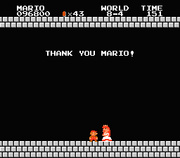
Here’s the thing: When I was you’re age (ugh, that feels lame) and we “won” a game where the goal (in the story) was to rescue/impress “the girl” (and that was most of them) here’s basically what we got:

And we were damn glad to get it! You kids have no IDEA how hard games had to be back when you couldn’t count on 1080p HD graphics and a looped Audioslave track to keep you engaged. One run through Level 8-4 of the original “Super Mario Bros.” and Master Chief would piss his armor rusty.

But you get to the end and there she is: The Princess. Granted, she’s only slightly more discernable as a princess than the “springboards” are as springboard (old folks, tell the truth: You wondered why jumping on an hourglass made Mario bounce,) but you’ve got the manual and the merchandising to tell you that those pixels represent a classically-kawaii Manga-esque babe, and she’s all your’s. That was enough.

That was 1986. 20 years ago.

Do you kids have ANY clue how good you have it? That gal was our reward for finishing the whole game! But you guys? This is one of the rewards you get just for doing pretty good for a bit in the new just-for-fun fighting game volleyball spinoff “Dead or Alive: Extreme Beach Volleyball 2.” Look:

So just THINK about this, y’little rugrats, the next time you decide to complain that the texture mapping isn’t perfect in this title, or that the “hair animation” doesn’t flow right on that character… just remember how lucky you are that that little Russ Meyer-esque throwaway gag above get’s to be part of your adolescence.

Ahem.

Hey, while I’m on “Dead or Alive“… hey, Hollywood! Can we get Corey Yuen’s “DoA” movie into some THEATRES already!? You’ve kept me waiting like a year for this thing:

Can you blame me? Out with it, already!

REVIEW: Happy Feet

George Miller is one of the great eclectic filmmakers to emerge in the previous few decades, an Australian director (and licensed physician) who’s work runs the gamut from his breakthrough in the genre-defining “Mad Max,” to the emotional drama “Lorenzo’s Oil” and even to the producer of both “Babe” movies (and director of the second.)

Counting “Happy Feet,” it can be said that Miller has been behind three phenomenal animal-related family films that all share two common traits: That they are excellent films… and that they are stunningly bizzare in the realm of mass-market family entertainment. “Happy Feet” is, without a doubt, one of the wierdest things that is going to play at a multiplex this year. It begins by (often literally) stacking oddity upon oddity just to set up it’s premise and world, and then proceeds to branch off into a quest story of straight-faced absurdity and metaphysical trippiness likely to rival anything we’re soon to see from “The Fountain.” The film may owe it’s financial backing to the megahit “March of The Penguins,” but it’s closer spiritual cousins are “Jonathan Livingston Seagull” or “Watership Down.”

The story plays out in Anarctica, chiefly among the massive colony of Emperor Penguins that call the vast ice-fields home. Emperor Penguins, we learn, are born with both the ability and the desire to sign pop songs to one-another, especially at mating season where the ability to blend respective “heartsongs” into a duet is paramount to hooking up. Elvis-crooning Alpha-male Memphis (Hugh Jackman) wins the heart of bombshell Norma Jean (Nicole Kidman) and soon enough a baby is on the way…

…but said Baby, named Mumble HappyFeet (Elijah Wood,) is born, well.. different. He can’t sing, not at all, and doesn’t seem to posess a “heartsong.” The only way he seems comfortable, indeed a prodigy, at expressing himself is through tap-dancing. Dance, however, is apparently “not Penguin,” and soon enough the Elders who reign over the religion practiced by the Penguins are declaring Mumble’s fancy footwork a blasphemy against their god, The Great Guin… and possibly the cause of the increasing fish famine that has imperiled their very existance.

Mumble, however, believes there may be another cause… possibly related to the strange stories of technologically-advanced “alien invaders” who’ve been overfishing the Arctic waters, (guess who,) and sets out on a quest to save his people… even as the Elders continue to insist that all solutions other than increased fealty to The Great Guin will only bring further punishment. His adventure will bring him new friends, harrowing encounters with predators (including the scariest Orcas since, well… “Orca”) clashes with the ideology of the Elders and even his family… and a “the HELL just happened??” third act that calls to mind nothing so much as “2001.”

Here we have it, without a doubt the finest musical ever made about a Penguin battling religious intolerance and “alien” invasions with tap-dancing as his only weapon. And believe it or not, describing it that way makes “Happy Feet” sound MORE normal than it actually is. Compounding the surreality is the atypical realism of the animation; the “humanization” of the characters is very limited, making all the singing and toe-tapping look all the more outlandish coming from what are basically photo-realistic Penguins. And the musical score, often a dizzyingly-complex medley of Penguin-remixed pop-standards, is a wonder of song-choice and sound editing.

George Miller has delivered a poignant, moving and geniunely beautiful film that is also one of the most original and unusually visionary movies of 2006. Listen close: You NEED to see “Happy Feet.”

FINAL RATING: 9/10

REVIEW: Casino Royale (2006)

James Bond has been “rebooted” a few times before, in fact the hiring of a new regular actor to take the role has usually led the producers to talk about new directions and big changes. “Casino Royale” is noteworthy because this time they actually mean it, setting the film up as an “origin-story” that officially starts the franchise over from point A.

Newcomer Daniel Craig (what you’ve heard is true) is the freshly-promoted Agent 007, already an overly-aggressive “blunt instrument” of a spy on the outs with his superiors. The mission, tailored to Bond’s in-agency fame as a card shark, is to mess with the poker-playing fortunes of “terrorist banker” Le Chiffre (Mad Mikkelsen) who likes to up his risk-factor by gambling with cash borrowed from his trigger-happy clients.

The thing about the Bond movies is that they are largely famous and beloved for the same things that they are mocked and called “dated” for: The outlandish bad guys, the zany gadgets, the jokingly-named femme fatales, the adherence to formula, and so on. The series’ first great entry was “Goldfinger,” featuring the nutty Fort Knox robbery scheme, the razor-brimmed derby and Pussy Galore; and it’s cast a long shadow over the all the later entries.

“Casino’s” solution, which probably owes it’s entire genesis to the success of “Batman Begins,” is to leave some of the trickier aspects of the series out (no gadgets, no Q, no Moneypenny) and hedge the series’ future bets with the fig leaf of “a new beginning”: The stuff people like will stay, the stuff people don’t can be removed and chalked up to “hey, it was just the origin!”

On it’s own, the film is a solid entry with (probably) the best script of the Bond series and great star debut for Craig, who’s easily the best Bond since Connery and gets the added bonus of playing the closest approximation yet to Ian Fleming’s original conception of a coldly fatalistic secret agent. Though here limited to more “earthbound” foot and car chases, shootouts and a painful-looking torture sequence, the action scenes are stellar and thankfully free of “Bourne”-style shaky-cam nonsense. And it knows not to throw out everything from the past: Dame Judi Dench returns as “M,” a role she’s occupied since the start of the Brosnan run. It was a gag at first, “ha-ha, James Bond takes orders from a tough older lady,” but somehow she feels appropriate for it still.

As for the larger picture of the reboot… I’m not gonna lie, I’ve always preffered the Bond films that more brazenly straddled the line between realism and outright fancy. My favorite installment remains “You Only Live Twice,” featuring the ninja army and the hidden volcano bad guy lair. I appreciate what they’re aiming for here, and understand what necessitated it… but I hope they won’t continue to be as restrictive to the “real” as the new series continues. Reality is fine, but I don’t want to occupy a movie landscape where all the supervillian hideouts are just hotel rooms, and the Oddjobs just carry guns.

…of course, if so, there’s always “The Transporter”…

FINAL RATING: 8/10

Only 4 more days until Wii…

Y’ever start out trying to respond to a simple message board topic and you wind up typing a freaking essay? I just did that over at 1up.com, on a thread about the relevance (or lack thereof) of the Super Mario Bros. game franchise. Came out (I think) decently enough that I figured I’d re-post it here, since the blog could use some lightening up here and there.

This would be the link:
http://boards.1up.com/zd/board/message?board.id=SpeakingUp&message.id=3147&page=4

And this would be the actual text:

What’s important about Mario, and why he/it still matters absent the nostalgia factor, is that he’s the “leader” of the ever-shrinking number of viable gaming icons who are unique unto gaming itself, and not a tweaked appropriation of some other trend or archetype. More and more, the “iconic” characters of gaming are simply re-appropriations of movie, TV or pop-culture “in” fixtures: Bad-ass super-soldiers, hip-hop infused ghetto warriors, and so on and so forth. And that’s just the ones who can still charitably be called “characters;” let’s not even go near the ones for whom “character” is beside the point: Does it really matter, in the scheme of things, that Master Chief is a near-total cypher when for 90% of “his” games “he” is just a hand holding a gun? (Hey, now there’s an idea… an FPS where the “hero” is literally just a disembodied hand! Tre-META!!!!)

It’s important, I think, that Mario is more than just an unofficial video game “version” of some other movie or TV hero. That his very LOOK is still defined in terms originally created because he was a game: The hat instead of hair, the mustache (to define the face) the overalls (to define the arms) all existed initially to allow him to be discerned in the limited graphical terms at the very genesis of the medium. As a character-model, he is gaming, born-of gaming; as opposed to gaming, born-of “Starship Troopers” (looking at YOU, Halo) or gaming, born-of whatever subgenre of crime movies Rockstar is riffing on this time (looking at YOU, GTA.)

In addition, I think there is a reason beyond pure nostalgia and “tradition” (and the fact that Miyamoto IS the greatest designer that will ever be and HIS Mario titles have remained consistently popular and re-port-able) that this particular character and franchise have endured. Think about it: It’s 2006. We’re on (at least) the third generation of post-SMB gamers, and Mario is still popular. Were the only “heat” coming from the aging members of Generation-NES, Mario and company would’ve been supplanted “g’bye Alex Kidd hello Sonic”-style years ago by Pokemon as Nintendo’s benchmark franchise. But when Nintendo needs a set of characters to build a party-game or goof-off sports-spoof title around, well… It’s not called “Pikachu Party.” There’s no “Squirtle Superstar Baseball.”

I think there’s a reason, perhaps not always fully realized why this figure still defines “game hero” for so many. Look at him: He’s not ripped, in fact he’s a bit of chub. He wears what are universally recognized as ordinary blue-collar work clothes, and a puffy hat that was out of style even before his silly mustache was. Even if you don’t still take “accidentally-warped Italian plumber from Brooklyn” as canon, everything about him says “this is an ordinary guy.” “This is an average man.” “This is an everyman.” But yet he gets to travel to strange worlds where he is not just a hero, but a super-hero – literally, a “strange visitor from another world with powers and abilities far beyond that of normal me.. er.. mushrooms.” And I’d argue that there’s something about THAT characterization, the unspectacular-spectacular man, that touches on something deep and all-important about WHY we play video games in the first place: A regular person becoming a hero in a strange new world sort-of defines the very act of engrossing oneself in a game, no?

Could it be that this, above all else, is what keeps drawing gamers to Mario? That the simple setup.. average-joe-as-dragonslayer.. serves as a kind of hyperrealized vision of the experience we hope to derive from the most satisfying of times spent gaming? The “fantasy” of the Super Mario Bros. franchise is, when you get down to it, that the ordinary man can be the Super Man. That a short, pudgy, blue-collar guy can travel to a new world, use magical powers, fight the monsters, save the day, become the hero and (especially) bed the hot Anime princess. Does that fantasy not, to a degree, encapsulate why gamers game? Most of us are average people. Most of us will never play in the NFL, fight the terrorists, go to space, fight the monsters OR, sadly, bed the hot Anime princess (though if you’re the guy with the “sweet” hotel room at E3 or ComicCon, you can increase you’re chances of bedding someone dressed just like one.) A good deal of us, I’ll wager (myself included) are even shaped a little bit like Mario, too.

And when we game, we can be like Mario. We can be heroes, we can see and use magic, we can slay the dragon and sometimes we can even save the princess. That’s what it comes down to, I think. Mario is all about what gaming is all about.

Lots of characters are in Video Games. Mario is Video Games.