“Hot Fuzz” is basically working the same British movie-geek joke that Edgar Wright and Simon Pegg’s last movie, “Shaun of the Dead,” was: Take a done-to-death, principally-American genre and drop it incongruously into a gently-satirical vision of merry ol’ England. “Shaun” found comedy gold by having a formula “zombie apocalypse” break out in the middle of a London suburb. Now, in “Hot Fuzz,” a Jerry Bruckheimer movie breaks out right in the middle of cottage country – with a plot deftly transplanted-by-inversion from “Beverly Hills Cop” and a style that’s half-mocking, half-celebrating every overblown actioner that followed “Bever Hills Cop 2.”
Sgt. Nicholas Angel (Pegg) is the (literal) supercop of London. A weapon’s-specialist, martial-arts expert, master investigator and by-the-book badass who’s 400%-and-climbing performance record is making the rest of his department (superiors included) look shabby by comparison. To rectify, they arrange to have him shipped off to a new position in Sandford, a picture-perfect pastoral village way out in the middle of nowhere with a crime-rate so low the big city Angel is reduced to busting under-age drinking, escaped swans and unlicensed rifles just to keep busy.
The downtime does, however, afford him the opportunity to work on his (standard movie-cop issue, of course) lack of social skills. Fellow Sandford cop Danny Butterman (Nick Frost,) an easily-distracted but good-natured oaf obsessed with police action films, takes an immediate shine to Angel – recognizing him as a “real” vision of the movie-cop’s he so admires. It’s here we get the first indications that this isn’t just another snarky takedown of action cliche’s. Like “Team America” before it, “Fuzz” is having fun goofing on the sillier points of the likes of “Point Break” and “Bad Boys 2,” but it also ‘gets’ what makes them so endearing – in this case the affectionate “buddy-cop” bonding routine.
It also ‘gets’ the fun of Michael Bay-style hero worship (ahem… Sergeant Angel…), as Nicholas finds himself unable to turn off his detective-skill paranoia, and starts to suspect that Sandford’s comically-high “accident” rate may be concealing some kind of sinister criminal conspiracy likely involving a local Supermarket bigwig (Timothy Dalton) who – like any good heavy of these movies – spends an inordinate amount of time strutting around acting like an obvious bad guy with something to hide.
What unspools, much like “Shaun,” eventually lets the genre-spoof take a backseat to outright genre-worship, and “Fuzz” unveils itself as an honest-to-God kickass action-comedy (after all, can you really “parody” something that’s already as much of a walking-joke as Michael Bay movies?) and also a surprisingly biting crack at the expense of rural British hyper-pleasantry. It even has some subtle fun goofing on Tony Scott-esque Ritalin-deprived editing tricks. And it’ll be hard for any other actioner this summer, “serious” or otherwise, to top it’s bullet-riddled third act for sheer audacity.
Short of “Grindhouse,” there isn’t a single move playing right now that’s more fun that this. See it.
FINAL RATING: 10/10
Category: Uncategorized
The sheep find their scapegoat
Gotta admire the speed at which the weak, the cowardly and those who prey on them have moved on this. The VT Massacre isn’t even a week old yet, and they’ve already found the pop-culture item that’s going to be blamed for “causing” Cho Seung-hui to murder people. Because, y’know, it can’t just be that random evil and insanity sometimes simply happen. No, that’s too scary. That’s too hard to face. Something must have “caused” it, and if they can just find what it is and raise a fuss, they’ll feel better.
Weaklings. Fools.
So, what’s it going to be this time? Chan Wook-Park’s movie “Oldboy.”
Why? Because apparently Seung-Hui had seen it, and because in one of his snapshots he was holding a hammer, and “Oldboy” killed guys with a hammer in one scene.
How perfect, eh? How clever the Encyclopedia Browns out there are: “OMIGOD! South-Korean movie! SOUTH KOREAN KILLER!!! IT ALL FITS!!!!” And, not for nothing, the film is a foriegn import, just like Hui himself, so they don’t even have the SLIGHT element of introspection that comes when they put the blame on American music/movies/whatever. Super, eh? Pro-censorship for one set of idiots, xenophobia for another.
What a disgrace.
The face of evil
I’m going to keep writing about this Virginia Tech massacre so long as there are things to say about it. This will, however, be the last time I include any images of Cho Seung-hui.

I include it here because it’s new and relevant, and because I think it actually is important we take a look at this creature and consider something.
So, look at him. Look at this posing, narcissistic, petulant little shit. Standing there before his own camera taking his army-guy dressup glamour shot, wearing his carefully-practiced “yeah, boy! I’m soooo gangsta!” scowl. Right down to the last detail of his obnoxious backwards ballcap. Look at that, and realize: That’s the last thing some poor innocent people saw on this Earth.
If there’s a Hell, he’d better be burning in it.
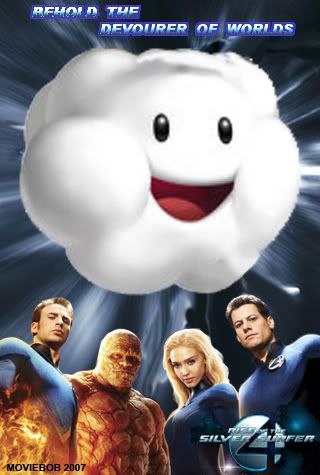
BEHOLD… Galactus?
(NOTE: May or may not be considered spoiler-esque. Strictly rumor-ish, one site had it under “spoiler,” another did not, I’m leaving some space just in case, click outta here if you’re really touchy about anything possibly spoiler-ish.)
…
…
…
…
Well, not exactly. But apparently it may not be all that far off:
http://www.joblo.com/hurricane-galactus
http://www.aintitcool.com/node/32330
And, before the responses kick up… I KNOW AICN isn’t exactly the New York times (not even the New York Post, really) but A.) It was put up by their most consistently reliable regular contributor, who is now their most “inside-the-system” regular contributor; and B.) It “sounds real” to me. Waaaaaay back even before we started seeing pics of the Silver Surfer, we were hearing that IF Galactus was to turn up in “Fantastic Four: Rise of The Silver Surfer,” he’d probably be closer to “Gah-Lak-Tus” (The “Ultimate Marvel” Galactus,) who’s basically a hivemind of billions of spacefaring insectoid robots which resembles a massive cloud at a distance.
For futher circumstantial evidence, we now have Variety…
http://www.variety.com/article/VR1117963368.html?categoryid=13&cs=1
…confirming that Laurence Fishburne is NOT voicing Galactus, as many outlets initially reported (giving rise to hopes that a human voice would logically equal a “traditional” humanoid Galactus) but rather the Silver Surfer.
Egh. Keep `em crossed… keep `em crossed…
On the plus side, if your name is Michael Bay, you can relax: You may get of lucky and end up as only the director of the second most-hated “tentpole” movie of 2007. See? God (…zilla 98) never flushes a turd without opening a window 😉
What can I say?
It doesn’t feel right to have a forum on which to say things and NOT say something about this most-recent shooting tragedy. On the other hand, I’m not sure I feel right trying to “think” of something to say when, overall, what can I possibly add? It’s a tragedy, it’s horrible, and… what else? This is a hideous act of seemingly-random evil that no one saw coming, proof both un-asked-for and un-needed of the cruelty and randomness that too-often “is” life… the very type of horror for which the term “unthinkable” was coined.
And then I watched the news, the very night of the event, during which time we did not yet even know this young monster’s name. I knew it was coming. I knew it was just a matter of time. I knew that their arrival was as innevitable as that of vultures to a carcass. I just thought it would take at least a day longer. But no, there they were.
The cynical, opportunistic “anti-gun” advocates of the so-called “left.”
The cynical, opportunistic pro-censorship advocates of the so-called “right.”
Both vile, both subhuman, both ready-by-reflex to “spin” this tragedy into an argument for their personal agendas. Disgusting. Depraved. Predictable.
NOW I have something to say.
GUNS DID NOT CAUSE THIS. My personal opinions and/or political thoughts on the subject of the 2nd Ammendment are not connected to that, it is merely a simple statement of fact. “Gun-control” laws, weapon-bans, regulation and any of the other “fixes” peddled cynically by the anti-gun guys in these instances are not a practical solution: The sick and the depraved will merely find other implements for destruction – not a single gunshot was fired, after all, in the carrying-out of 9-11. The Unabomber and Tim McVeigh both used explosives. Those who seek to destroy will seek to destroy, limiting their options merely makes them creative.
EXPLICIT MOVIES, TV, MUSIC & VIDEO-GAMES DID NOT CAUSE THIS, EITHER. My feelings on this are no secret. There has never been, nor is there ever likely to be, conclusive proof or even reasonable evidence to suggest that there has ever been a film, television show, song, game or other work of art that “makes” people do horrible things. Censorship (“self” or otherwise), stricter-ratings, the enforcement of the “family hour,” or any of the other “fixes” peddled cynically by the pro-censor “conservatives” (and “liberals,” too: looking at you Mr. Lieberman, Mrs. Clinton) are an even less practical solution: The sick and the depraved will simply find other sources to claim “inspiration” from: Hitler loved Wagner. Manson loved The Beatles. Ben Franklin had it right: “Those who would give up Essential Liberty to purchase a little Temporary Safety, deserve neither Liberty nor Safety.”
You know what caused this? A CRAZY MAN. You know what worsened it? APPARENT MISMANAGEMENT ON THE LAW-ENFORCEMENT SIDE.
I know that that’s not especially comforting. Even though most of us know it on one level or another, no one “likes” to confront head-on the idea that life can be – and so often IS – cruel, unjust and random. That sometimes bad things happen without some definable, “removable” cause. That horrific evil can occur without warning and end without justice. It’s not “right.” It’s not “fair.” And it’s entirely understandable… indeed entirely human… to be tempted to believe that there always MUST be something to “explain” it, something to have “caused” it. Something which we can find, grasp and maybe even “cut-out” like a polyp or an infected hangnail. But when we succumb to that temptation… when we drop to our knees and beg (knowingly or otherwise) for someone – anyone – to come along and give us something – anything – tangible to “blame”… we leave the doors to our very will open – keys still in the ignition – for anyone to come along and take control of.
Our spirit, our will, our very selves… become weak. And the charlatans, false-prophets and demagogues on all sides and of all stripes specialize in preying upon that very weakness. They want to use your fear, your insecurity, your desire for an “answer” in order to bend you to their will and add your voice to their agenda.
Don’t let them.
Don’t be weak.
Be STRONG.
Strength is built through resistance to force and pressure. In this case, resistance to the force of sadness, horror and injustice that beat down on us in these kind of dark times. And the the pressure of those political snake-oil salesmen. who’d use any sign of vulnerability to bend you to their agenda. If you support gun-control, censorship, whatever… fine – but support them because YOU honestly do, not because some sleazebag pundit convinced you supporting them would be a “get-meaning-quick” fix.
Be Strong. Stand eye-to-eye with LIFE and let it know you are not afraid. That you are well aware of how cruel and random and unjust it can be… but that you’re still here, with a strong will and a free mind… and you can take it.
P.S. Members of the news media: We are now all aware that this is now “officially” the “worst firearm massacre in American history.” We get it. It’s significant, it’s a moment in history, and you got to cover it. Fine. Now can we please stop announcing this little psychopath’s body-count like it’s some kind of goddamn sports statistic?? Remember, the thing about keeping records is that someone is always looking to break them.
Another new "Transformers" clip to make you feel dead inside
Batman has pointy ears. Daredevil has horns. Superman wears a cape. “Zelda’s” Link sports of floppy, pointy hat. Godzilla has leaf-like back spines. Hobbits have fuzzy feet. Charlie Brown wears a yellow shirt with a wraparound jagged-line design. The Super Mario Bros. wear overalls and hats with their initials on them. The Lone Ranger, Zorro and The Spirit all wear masks.
These are simple, basic design-elements. Easy to remember, instantly-identifiable visual traits that make characters recognizable. The “icon” part of the term “iconographic.”
Also on that list, at least as far as I’m concerned: Optimus Prime doesn’t have, or require, a visible mouth. Except that now he does:
http://iesb.net/index.php?option=com_xevidmegafx&Itemid=139&func=detail&id=457
And the ongoing saga of “Godzilla 1998: Take Two” continues. Sigh…
Already a couple of you are rolling your eyes. “Silly fanboys, getting all worked-up about minor changes to a bunch of dopey old toy robots.” It’s almost not even worth trying to explain anymore, but the general “fanboy” malaise over these re-designs most-definately isn’t just a bunch of overgrown children complaining about a screw out of place here or there. Character-design changes are usually welcomed by all but the most deeply obsessive… When they’re good. You won’t find many Batman fans, for example, all that upset that the movie/animated-series Bruce Wayne does his crimefighting in a black cowl as opposed to the comic’s traditional blue. The claws come out when re-designs are BAD: Think the innexplicably be-nippled Batman of “Batman & Robin,” or the aforementioned 1998 American bastardization of Godzilla.
Right down the line, the nominal “stars” of “Transformers,” even setting aside the pre-existing comic/toy/cartoon designs, are some of the worst-looking cinematic robots in recent memory. They all look like asymetrical, unwieldy scrap-metal sculptures. This is the very definition of OVER-DESIGNED; obviously the art department guys had a ball figuring out all the little gears and bits and intricacies, but moving around at large scale they look like ass, plain and simple. And now, thanks to the above TV spot, we now know that – in addition to the moronic “whoa, dude!” flame decals – Optimus Prime now sports a ridiculous-looking pair of liquid-metal monkey lips. Oh, well.
But enough moping. Some nice fellow on YouTube put up this clip from the recent live-action version of the oldschool Japanese anime classic “Tetsujin 28” (“Gigantor” to us Americans.) The video-quality isn’t spectacular, and there aren’t subtitles, but still… take a look at what you get when big-budget CGI giant robot movies are made by people who actually give a damn:
http://www.youtube.com/watch?v=ooma9dvfZwk
And since I’m not able to embed that one, apparently, here’s the trailer:
I’ve got this on DVD (so can you, Geneon has a fine English Subtitled version out in general release they didn’t publicize for whatever reason) and let me tell you: They probably spent less making this whole movie than it likely cost to cater the “Transformers” set for a week (I mean, can you imagine how much it costs to get a fresh village maiden for producer Don Murphy to drain of blood every day??) but it’s fun as hell, has charm to spare and it’s giant robot sequences kick visual ass on a level Michael Bay couldn’t attain if he was mainlining mescalin atop Mt. Everest.
REVIEW: Aqua Teen Hunger Force Colon Movie Film For Theaters
It’s not really possible to describe WHY “Aqua Teen Hunger Force” is funny. It just is. That more or less sums up the entirety of the “in-house” produced fare that runs on Cartoon Network’s nighttime “Adult Swim” block. Oh, there are “jokes,” yes, but the majority of the humor is organic; derived from the rambling oddities spewed from the “mouths” of nominally-animated characters imbued with gloriously unhinged, definable-yet-hard-to-pin-down vocal performances. The voice-actors inhabit their strange, largely self-created dreamscape in a manner that’s much more characterization than “schtick,” resulting in humor that (in it’s best spots) brings to mind the famous positive critique of “Rocky & Bullwinkle” calling it “a very clever radio program with the bonus of accompanying drawings.” (or something to that effect.)
Which is a very “fancy” way of saying that I have no freaking idea how one is supposed to review “Aqua Teen Hunger Force Colon Movie Film For Theaters.” I can tell you that it’s incredibly funny, that one part in particular (and opening gag spoofing vintage movie theater pre-show ads) may end up being the single funniest piece of film of the entire year, but also that it’s not quite the second coming of the “South Park” movie, etc. I could tell you all that… but I can’t really say “why.” It just is.
It’s tempting to take the easy route and say (as the film does) that no one who isn’t already a “convert” to the Aqua Teen fanbase need not apply, but I don’t agree. On the contrary, fans of this style of humor who haven’t yet seen the show will have benefit of encountering the recurring “bits” and guest-characters freshly. Of course, that begs the question of exactly WHAT this style of humor even IS…
But, for the record: The Aqua Teen Hunger Force (the characters originated as a creepy sendup of fast food mascots on “Space Ghost Coast to Coast” and gradually evolved into their present form) is a ‘superhero’ team of talking food items: Super-smart Frylock, a box of fries; childlike Meatwad, a meatball, and obnoxious Master Shake, a milkshake. They don’t really “do” much hero-ing, though, prefering to slack around their rented New Jersey house, bug their slovenly neighbor Carl and let all manner of supernatural strangeness come to them. Try to imagine a hybrid of “Fantastic Four” and “Sandford & Son.” Except they’re all food. And not actually anything like that.
If there is a specific, overriding “theme” of the gags in the movie, it’s the idea of a self-effacing ribbing of the very nature of it’s being: i.e. big-screen feature versions of animated cult TV shows; and all the mandatory “promise” they’re supposed offer of larger-scale adventures, multi-character cameos, backstory revelations and long-in-coming showdowns or character turns. To this end, the ATHF confront a potential apocalypse in the form of a demonically-powered exercise machine, “The Insanoflex”… but it’s a bit unclear as to how or WHY this thing is going to end the world. Perennial fan-fave bad guys The Mooninites, The Plutonians, Dr. Weird and the Cybernetic Ghost of Christmas Past are all on hand… not necessarily “doing” anything. Fans may or may not have been waiting to see the “final battle” of Frylock and Dr. Weird, but they’ll get it… sort of. And we finally get to learn the secret origins of the Aqua Teens… or maybe we don’t… or maybe we do.
It’s kind of impressive that this thing works at all, considering that if ANYTHING has a dubious chance of working as a feature film a 10-minute cartoon short certainly qualifies. But, somehow, what’s finally just a slightly-more-elaborate, nines-times-longer version of the show fits together pretty damn well. Or… maybe it doesn’t. I dunno, at times this is sort of like trying to divine if Picasso actually knew how to draw. What I do know is that Bruce Campbell turns up, as does “Rush” drummer Neil Pearth. And that’s pretty damn awesome, right there.
FINAL RATING: 7/10
Uwe Boll crosses "the line"
People, this is WHY you need to listen to the Geeks on these things.
For the last several years, the Geek Community has been trying to warn people about Uwe Boll, director of “House of The Dead,” “Bloodrayne,” “Alone in The Dark” and possibly the most singularly awful filmmaker working today. These warnings have been ignored and brushed-off, because after all “who cares” if some Z-list German filmmaker is making crummy adaptations of video games? After-all, screwing up an entry in a genre the mainstream holds boundless contempt for isn’t regarded as any kind of cardinal sin to “most” filmgoers, critics, etc.; and the Geeks were just being “silly” when we called him EVIL.
For awhile now, Boll has been hyping up his latest disasterpeice, “Postal,” by boasting that he was embracing ultimate shock-value by peppering the film with (among other things) “9-11 jokes.” No one was really sure WHAT he actually meant by that… by now we have what is apparently the “leaked” opening to the movie courtesy popular anti-Boll website Bollbashers.com – depicting a World Trade Center window-washer getting wiped-out by the first plane. No, really.
Take a look, but you have been warned:
http://www.bollbashers.com/trailers/postal_clip.mov
There’s no secret to what’s up here. Boll isn’t talented, so he’s angling for newsworthy controversy in order to get attention for another bad movie. It’s natural to see this and get worked-up and call for boycotts, bans and the man’s head… but he doesn’t deserve the credit or the time. He’s a despicable human being, something the Geek World has known for three movies and counting now, and he deserves only to continue getting what he’s already BEEN getting: Hate and scorn from us, general indifference from the rest of you.
REVIEW: Grindhouse
The trick to the retroactive affection for “Grindhouse” (read: low-rent urban movie theaters in the 70s and 80s) era movies is in understanding that they aren’t good. That’s not the same as saying that they weren’t entertaining, worth-watching and even worth preserving and celebrating long past their shelf-date; but it’s important to take them at what they were and not get TOO carried away by those who like to claim – based on VERY shaky analysis and some HEAVILY cherry-picked examples – that the “genre” (category, really) was uniformly some sort of subversive, sociologically-important treasure trove like the similarly-rescued “Film Noir” entries turned out to be. Nostalgia isn’t powerful enough to turn a Big Mac into the cure for cancer.
Fortunately, the above-described pretense isn’t really what Quentin Tarantino (surely the High Priest of post-millenial Grindhouse Worship) and Robert Rodriguez (his most accomplished acolyte) are up to with “Grindhouse,” an epic-length 2-movie gagfest framed as a “double feature” of two (mostly) complete feature-length films by each man recreating various feels of the various “Grindhouse” subgenres, plus faux-trailers for similar (phony) films and wacky era-appropriate ads. As you might guess, the making of this has essentially entailed both men writing themselves a license to jam their favorite recurring actors, themes and fetishes (both visual and otherwise) into an asthetic where crude, sensation-focused disregard for narrative finery is considered a blessing and cut the hell loose, playing around with wacky dialogue, unlikely scenarios and jokey digital “film scratches” and “reel missing” jokes to their heart’s content. Make no mistake about it: What you’re watching is masturbation, plain and simple; but if (the rather Grindhouse-y itself) “Body Double” taught us anything, it’s that masturbation can in fact be quite diverting given the proper “performer.”
In the broadest sense, there are two categories of “Grindhouse” films: The ones that actually WERE consistently entertaining and diverting because of the freedom afforded by the loose strictures of low-budget “sex and gore” filmmaking; and the (more common) entries that were largely forgettable (and usually rather talky) save for one or two unique/noteworthy elements that made them pop-culture immortal…”You won’t BELIEVE the car chase in this one!,” “THIS is THE MOVIE where ______ is topless!,” etc. Rodriguez has made the first kind, Tarantino the second, and while both evidence a frighteningly-precise familiarity with the form they’re also (thankfully) both cheating just a bit: Rodriguez’s “Planet Terror” nails the “as much as you can, however you can” kitchen-sink buzz of early-80s Golan Globus offerings – but with special effects and cinematography flourish that the “real thing” could only dream of, while Tarantino’s “Death Proof” painstakingly recreates the “pad-it-out-to-90-minutes” talkathon’s of mid-70s car-crash entries – save that instead of space-filling jabber his characters are spitting out.. well, vintage Quentin Tarantino dialogue. This isn’t Grindhouse Cinema they way it was, it’s Grindhouse Cinema the way it’s remembered.
“Planet Terror,” the opening feature, is a lockstep John Carpenter/George Romero knockoff about various hard-bitten characters fighting off a zombie/virus outbreak in and around a rural army base. Dark-past-sporting scallawag El Wray (Freddie Rodriguez) stripper Cherry Darling (Rose McGowan finally in a juicy lead part) and hard-luck-lesbian-fleeing-abusive-psycho-husband Dakota Block (Marley Shelton) are the principal good guys, an uncredited Bruce Willis as a preposterously-backstoried paramilitary leader is the heavy, and an army of puss-oozing cannibal infectees provide the canon fodder – exploding in bursts of jet-propelled good that looks absolutely nothing like actual blood as the goodies mow them down with bombs, bullets and blades while genre/Rodriguez-Tarantino veterans like Michael Parkes, Michael Beihn and Jeff Fahey (!) dash around the margins making mischief and adding to the action.
You’ve seen most of the best bits of “Planet” in the trailer, including Cherry’s improbable but glorious employment of a (functional) machine gun as a post-amputation artificial leg and the best use of a helicopter as an anti-zombie weapon since “Dawn of The Dead.” But the peice never gets dull or wears out it’s welcome thanks to the “into it” cast and Rodriguez vaunted gift for concieving mind-shreddingly original ways to off bad guys and stage mass-carnage. He’s visibly liberated, by the inherent put-on nihilism of the style he’s recreating, from what little connection he had in the first place to the traditional concepts of formula – literally sending the story and characters in direction you can’t imagine a “sane” filmmaker going (I’ll predict that the exit of at least two characters from the film will turn some folks right off before it’s even half over.)
“Death Proof” is an entirely different animal, even if it’s breathing most of the same fumes as “Planet.” Overall, it’s the superior of the two entries in terms of execution, but it’s also going to be the most “difficult” for most audiences – even the ones garaunteed to be there with bells on for the movie-proper. Here, Tarantino opts to not only celebrate but also deconstruct and ultimately reinvent the least accessible “side” of the Grindhouse experience: Heavily-padded, overall-forgettable bad movies memorable for a single performance, theme or scene. It conjures up a formula stalker-thriller about a crazed stuntman who gets off murdering young women with his “death-proof” musclecar, featuring a live-wire turn by Kurt Russell as the psychotic “Stuntman Mike,” an ultra-memorable crash sequence, a car-chase that’s one for the ages and… a lot of time-filler chatter in between.
In that respect, it (“Death Proof”) feels just a bit more on the authentic side, for better or worse. It’s easy to imagine a “real” version of this movie, one that would be reccomended with great enthusiasm by… well, by hardcore film geeks like Quentin Tarantino, really… to friends for the “insane!!!” performance Russell gives or “one of the ALL-TIME greatest car chases!!!” in the final act – immediately followed by the caveat that “you’ve gotta sit through A LOT of talk-scenes to get to the ‘good parts,’ but it’s soooo worth it” and the knowing observation that they’ve attempted to compensate for “all the dialogue” by putting it in the mouths of super-hot actresses. The difference here is that Tarantino, as a writer, is never better than when he’s putting longform conversational chatter in the mouths of quick-witted hotties and hard-nosed genre vets. The non-action sequences of “Death Proof” play out like filler because they ARE filler… but GOOD filler in the form of some of Tarantino’s best marathon squawk-session writing since at least “Jackie Brown.”
The first half of “Death Proof” is dominated by mood, music and Russell’s switched-on stalker vibe. But the second half, despite the (understandable) hyping of the inhumanly-beautiful Rosario Dawson, reveals itself as a surprise star turn evidencing (once again) Tarantino’s uncanny ability to spot a “movie star” in unlikely performers and craft roles specifically measured to unleash them: This time it’s Kiwi stuntwoman Zoe Bell, Uma Thurman’s “Kill Bill” stunt double hear playing “herself” as part of a tight-knit group of film-industry girlfriends who go from being Stuntman Mike’s second batch of potential victims to his table-turning avenging angels… and, heaven help us, he’s done it again.
Bell, who’s career to this point has largely involved doubling for female action-heroes, is a bona-fide STAR in her own right, and it’ll be entirely unsurprising if she doesn’t start turning up AS the star of action movies after this. The initial impetus for her casting, it would seem, is to give authenticity to the incredible car-stunt sequence she takes part in… but it’s led to the most remarkable “star turn” by a stuntperson since Ray Park stepped onscreen as Darth Maul. She’s a uniquely-lovely, immediately-engaging actress with a cute Kiwi accent; and the way she goes throwing herself at the chance to drive a car “just like the one from ‘Vanishing Point!,'” engage in a ridiculously dangerous-looking stunt game or take down a road-killer maniac with the same gung-ho “pep” is downright infectious.
There’s a distinct possibility, it must be said, that Rodriguez and Tarantino may have created a monster here. It’s depressingly easy to imagine lesser filmmakers using the “grindhouse homage” fig-leaf as an excuse for more general ineptitude, slapping digital film-grain and synth-scores over bad movies and hoping to “fake” some of the magic. It won’t be the first time either man has “started” something not-altogether positive (how many bad films have YOU seen that obviously wanted to be “the next Pulp Fiction!” or “Desperado?”) And at the end of the day there isn’t really much “to” “Grindhouse” beyond it’s theme-park-ride/nostalgia intentions. It’s an “event movie” for a niche audience that typically feigns apprehension of “event movies,” a “have you seen it?” touchstone aiming for audience-participating and repeat veiwings. In other words, it’s a blockbuster… and we should be so lucky that all blockbusters actually made so good on their vow to entertain.
FINAL RATING: 9/10
REVIEW: Reign Over Me
Mike Binder has been writing, directing and appearing in his own unique, personal little movies for awhile now. In fact, he was doing it before it was “cool.” Only recently, following the cult-y reception for his HBO series “Mind of The Married Man” and the modest but notably warm reception to “The Upside of Anger,” has he started to emerge onto the mainstream filmmaking “stage” as a name of some note. For a change, the reason for this is easily defined: His films have gotten much better, informed at both the technical and the storytelling level by wisdom that can only be learned through hard work and the living of life. His movies have gotten sharper, deeper and smarter because he has. And whatever else it may be, “Reign Over Me” as it stands could only have been made by someone who’s “put in his time” to get to this point.
His films tend to share certain reccuring attributes. Primarily, Binder makes adult-targeted relationship dramas with interwoven elements of humor. His films tend to be fairly lengthy and deliberately-paced, with lots of “breathing room” and ample multitudes of characters and subplots to occupy all that space. By and large, his characters tend to be broken, fractured, disordered or otherwise flawed; and usually wearing it on their sleeves. But none of that is what genuinely distinguishes Binder from those working in similar material. Rather, it’s the following key difference: His movies are seldom, if ever, primarily concerned with problem-solving.
Most films, even the really “smart” ones for “grown-ups,” have the following presumed-truth at their foundation: That there is a single, recognizable, attainable “correct” ideal state to life, the universe and everything. The majority of dramas concerning people with problems hold said problems as a mere deviation from the “correct” state of things, make the correction of said problems the main thrust of the plot and conclude when all or most of said problems are “solved” and normality is restored. For the most part, this is not how Mike Binder movies work, and it’s definately not how “Reign Over Me” works. His characters tend to understand (though not always right away) that there is a difference between a problem – which sometimes must be smoothed-out, managed, “lived-with” but not always “solved” because, well.. because that’s life, and because our problems are a part of us – and a crisis – which CANNOT be lived with and MUST be solved, even if it means setting the solving of smaller problems aside for a moment. In other words, at the end of a Mike Binder movie, chances are a character with a noteworthy character flaw will probably still have it.. though they’ve likely learned to control it, live with it or “smooth it out,” which can be a little disorienting since so few dramas play out this way.
For example, in “Upside of Anger,” the characters are all walking repositories of issues and problems: Joan Allen’s bitter disconnect at being romantically adrift in middle-age, Kevin Costner’s ambivalence at having “peaked” young and facing continued life in post-fame limbo of even-ness, the young daughters’ various brushes with eating disorders, promiscuity, etc. All of those problems are still there, though smoothed-out and livable-with, at the end. It’s only the crisis, in this case Allen’s unrequited/self-consuming anger at her husband’s supposed abandonment, that has been resolved. And thus the characters are, in a profoundly real and human way, “okay,” because having problems and still being okay is what real humans do. It’s what we are.
“Reign Over Me’s” lead person-of-problems is Alan Johnson (Don Cheadle) a New York Dentist. He runs a successful practice… but he’s quiet, timid and his partners are openly disrespectful of him. He has a lovely wife (Jada Pinkett-Smith,) great kids and a fine home… but his wife is just-this-side of “controlling,” and he’s accutely aware that he has no real hobbies or outside life unto himself. His most notable “relationships” outside his home are with Angela (Liv Tyler) a therapist who shares his building and endures the daily sleight of not being taken seriously because she’s “too young,” and his patient Donna Remar (Saffron Burrows,) a divorcee so profoundly screwed-up in the self-esteem department that she turns up in his office practically begging for the opportunity to perform oral sex on him… despite the fact that she’s so stunningly attractive that another character later observes “no one has the right to go around looking that good!” (seriously, take a look: http://www.celebritywar.com/pictures/saffron-burrows.jpg )
MINOR SPOILERS (depending on which trailers you’ve seen) FROM HERE ON OUT
The story-proper kicks in when Alan meets up by chance with Charlie Fineman, (Adam Sandler) an old college roomate who he hasn’t seen in over a decade. As far as anyone last remembered, Charlie was also a dentist and also had a comfortable wife-and-kids family situation going on… but when Alan spots him on the street he’s a shaggy, unshaven, tattered mess – cruising the midnight streets on a motorized scooter, classic-rock songs blasting away on his headphones and speaking in a halted manner that suggests a form of autism.
The reason for Charlie’s transformation aren’t really approached as a “surprise,” but have been slightly glossed-over by most of the television advertising: His wife and daughters are dead – they were passengers on the hijacked planes of September 11th. Unable to cope with the loss, Charlie has regressed to a near-catatonic state of Post Traumatic Stress Disoder, psychologically incapable of admitting that he ever had a family and prone to semi-psychotic outbursts at the suggestion. He flees in panic at the sight of his well-meaning but perhaps-misguided in-laws (Robert Klein, Melinda Dillon) and seems to have no knowledge of the fact that Sugarman, the accountant in charge of managing his considerable surivor’s-relief funds (Binder,) was his best friend… up until September 10th.
He latches onto Alan’s friendship as the only person who “know’s him” but doesn’t have any connection in memory to his lost family; while Alan latches onto Charlie for reasons both altruistic and selfish.. but also understandable: On the one hand, he senses the need and opportunity to help a friend; while on the other hand part of him clearly enjoys/envies the rules-free, quasi-adolescent existance that Charlie has created for himself in his dementia. It’s important, vital in fact, that neither man is precisely “unaware” of this dynamic. Even Charlie, demonstrably, isn’t in “denial” in the traditional sense: He KNOWS what the truth is, and he’s slowly driving himself mad trying to force denial upon his psyche.
Alan’s mid-life crisis and timidity, his wife’s controlling, Charlie’s possibly-permanent PTSD, the in-laws well-meant nosiness, Mrs. Remar’s myriad issues and even Angela’s inescapable youthfulness are the problems, and the setting of permanently-altered post-9/11 Manhattan (the film’s New Yorkers never even call 9-11 by it’s name, but no one ever needs to ask what is being spoken of) is as solid an indicator as any that Binder intends to let his characters once again deal-with, but not necessarily “solve” them. The crisis, on the other hand, is that Charlie is only growing more and more unstable and self-destructive. And while the film’s third act between opposing forces that wish to forcibly “fix” his damaged pyshce (the in-laws) and others who want to help him find his own way “back” (Alan, Angela, Sugar and eventually even Donna) it’s a point of zero-contention that something has to be done. Somehow, someone has to help him accept that he can go on living even with the knowledge of what he’s lost.
Let’s put it on the table right now: This is the best movie Mike Binder has made, period. It’s also one of the best movies of the year, one of the best “after 9/11” dramas and contains Adam Sandler’s best dramatic performance. Ever.
Binder has just-about worked out every nagging issue that had mired his previous work. The length doesn’t feel too-long, the multiple characters and subplots all fit together organically (even Burrows’ Remar, who at first seems so improbable that she may as well have wandered by accident from a nearby masturbatory fantasy, eventually feels real) and the melodrama/buddy-comedy mix doesn’t feel an innapropriate fit. The drama works. The relationships are potent and human. The funny parts are funny, the sad parts are shattering, and even when it heads into the potentially-cliche’d realm of “Big Courtroom Scenes” or “Therapy Breakdowns” it’s willing to go far enough to earn them.
See this movie. You owe it to yourself.
FINAL RATING: 9/10